Quick Answer
A business can buy fresh flowers wholesale for events, shops and offices and spend less than florist prices, as long as someone has time to condition and arrange the stems.
The buyers who pull it off share three habits. They keep the design to greenery and one focal flower. They line up help that knows how to handle stems. And they finish the arranging two days out, not the night before. Plan that way and the savings stay in your budget instead of leaking into a late night of rescue work.
Key Points
- Grand View Research's 2026 report found the commercial segment accounted for 77.1% of global cut flower revenue in 2025, with hotels, restaurants and corporate offices among regular buyers.
- The Society of American Florists said in 2023 that buying in bulk can save money "only if a florist can sell the stems and minimize shrink."
- Blooms By The Box guidance: order 2 to 3 weeks before delivery, schedule delivery about 2 days before the event, and give stems at least 3 to 5 hours to drink.
Before you compare flower sources, price the whole order, shipping and every checkout fee included, not just the stems. Skip that step and the savings shrink fast.
One commenter in a March 2026 Reddit thread on DIY florals put it bluntly: "Wholesale sounds cheaper until you factor in the logistics." I'd say it a little differently. Count the hands you'll have on delivery day before you count stems.
A July 2025 thread on Reddit's r/weddingplanning forum spelled out what that work looks like. One buyer warned that bulk stems mean "a LOT of labor the night before (processing, hydrating, arranging)," and suggested you "order 20% more than you think you need because some stems always arrive sad." The same thread advised giving every stem a fresh cut and an overnight drink in a cool, dark place before anyone starts arranging.
That extra margin has a name in the trade. Buffer stems are the extras you order on top of your count to cover a bent neck or a bruised bloom. For example, a shop planning a window display orders a few more stems than the design calls for, so one damaged rose never leaves a gap.
A buffer matters even more for a business than for a one-time party. A hotel lobby can't show a hole. Neither can a client dinner.
So this guide walks through the decisions in the order you'll face them: wholesale or florist, how far ahead to order, which fresh flowers hold up in offices and storefronts, and how to condition every stem the day the boxes land.
More than 1 billion imported cut flowers had cleared federal inspection by Feb. 6, 2026, and Valentine's Day hadn't even arrived. Every shop, hotel and planner buying in bulk draws from that same stream.
U.S. Customs and Border Protection said it expected to top the previous year's record of 1.3 billion stem inspections before the holiday. That's a lot of flowers. It also means the busiest weeks fill up fast, and the buyers who plan early get first pick.
You already know fresh flowers make a lobby, a storefront or a reception table feel cared for. The harder part is keeping them coming without paying retail every single time. Here's my answer: buy bulk wholesale flowers, order well ahead, and give the stems time to drink before anyone sees them.
Bulk flowers are loose stems sold by the bunch or the box at wholesale prices, ready for you to arrange. For example, a hotel can fill its lobby urn from a few bunches of eucalyptus and lilies instead of paying for a finished arrangement every week.
Let's start with the question most teams ask first, which is whether to take this on yourself at all.
Questions this article answers
Should a business buy flowers wholesale or pay a florist?
Buy wholesale when you have a plan, a place to condition stems and a few hands to help; hire a florist when nobody on your team can handle fresh flowers.
Wholesale flowers are stems sold in bulk bunches at the price florists pay, before anyone designs them. Think of it as buying the ingredients instead of the finished meal. Before you order, run through these four questions:
- Space: Do you have a cool room, out of direct sun, with room for buckets of water?
- Time: Can someone unpack and hydrate the flowers the same day they arrive?
- Skill: Does anyone on your team know how to recut, strip and arrange stems?
- Repeat use: Will you buy again next month or next season, so the routine pays off twice?
Three yeses to the first three questions? You're ready for wholesale.
Wholesale stems cost less than a florist's finished work. Where those savings leak away is handling. In a long-running WeddingWire forum thread, started in 2010, a florist described clients who planned to do their own flowers and handed the job back in the final week because the stems weren't conditioned properly. The catch she named is the whole job: bulk stems have to be re-cut, conditioned in floral solution, stored properly, arranged and carried to the venue.
That isn't a reason to skip wholesale. It's a reason to plan the handling before you place the order.
The common assumption is that wholesale is only a price decision. It is also a handling decision, and the handling is where a business either keeps the savings or gives them back.
Here's how I think about it for business buyers. We ship premium fresh flowers anywhere in the continental United States, so an office manager in a small town can work with the same stems as a planner who lives near a big flower market. Our wedding work has been featured on Style Me Pretty, Ruffled and Wedding Chicks, and the unpacking and hydrating routine behind those weddings is the same one that keeps a hotel lobby arrangement or a shop window looking fresh.
The pattern across those accounts is the same: the buyers who succeed treat flowers as a short, planned project rather than a last-minute errand.
For example, picture an event planner before and after. Before: she orders the week of a fundraiser gala, the stems land with no one free to process them, and she spends the night before re-cutting alone. After: she orders weeks ahead, books helpers for delivery day, and starts arranging with hydrated, opened blooms and time to spare. Same flowers, very different night.
If you're weighing a bigger event budget, our walkthrough on whether $5,000 is enough for DIY wedding flowers lays out the math line by line. The bigger question for a business, though, is why so many commercial buyers are making this switch right now, and the market numbers answer it.
Does buying flowers wholesale still save money once you count the work?
One wedding's flowers, 23 finished pieces, cost about $850 at wholesale. The number that rarely makes it into the budget is how many hours those 23 pieces took to make.
The figure comes from a March 2026 thread on Reddit's r/wedding forum. A couple made a bridal bouquet, 6 bridesmaid bouquets and 16 table centerpieces from wholesale stems, and said the total came out "pretty significantly cheaper than it would have been to have a florist gather and assemble everything." Our own average wholesale price for bulk wedding varieties is $3 to $4 a stem. On price alone, the stems are the easy part of the math.
The harder part came after pickup. From there to "basically finished with everything," the poster wrote, the job took "about 6 hours between 6 people." Six people for six hours adds up to 36 person-hours, and no receipt shows them.
Katherine Raz ran the same math as a business owner. When The Fernseed, her plant shop in Tacoma, Washington, first sold Valentine's bouquets in 2020, she wrote: "If it takes one designer 20 minutes to make a bouquet, that means they can make 24 bouquets during the course of an 8-hour work day, not counting breaks." Prep came on top: unboxing, unwrapping, stripping stems and removing thorns.
Design choice is where a buyer has the most control over those minutes. In the same Reddit thread, a second bride spent $300 on hydrangeas, peonies, roses, eucalyptus and freesia for ten tables. Each vase took about 5 minutes. Flower prep took about 2 hours and setup at the hotel about an hour, and she did all of it herself. A commenter who said they had watched dozens of couples try DIY wholesale wrote that the ones who pulled it off "kept the design simple (greenery and one focal flower)."
Labor is one cost buyers miss. Stems that never earn their keep are the other. The Society of American Florists, the industry's trade association, put the condition plainly in 2023: buying in bulk can save money "only if a florist can sell the stems and minimize shrink."
Raz's Valentine's run shows what happens when the sales side falls short. Her shop pre-sold 55 bouquets for a single pickup day, brought in freelance designers, and Raz wrapped bouquets until midnight two nights running. The goods alone cost $3,404, against $2,680 in sales. That left a $724 gap before another $3,832 in expenses, and the holiday ended with a $5,056 net loss. She wrote that "it was a logistical success!" and added, "But it was a financial failure." One shop's single holiday cannot tell you what is typical.
Holidays tighten the squeeze. Raz wrote that "during busy holidays, this creates a labor bottleneck," and a business buying for Valentine's week or the December party season feels the same crunch at the work table.
When the hours become real, many buyers change their plans late. Karen Guyt, a florist answering a WeddingWire forum question about wholesale versus a florist, said about half of her clients who plan to do their own flowers ask her to take over the week before or later, and about a quarter more should have, because their flowers were not handled properly. She gains when clients come back, so treat her figures as one florist's experience.
In every case here, the stems were the cheap part. The job that lost money was the one where the order outran its sales, and the plans that fell apart were the ones that outran the hands available. The savings from wholesale are real, and you collect them at the work table.
Before you place a bulk order
- Count hours before you count stems. Give each piece realistic minutes and add a prep block. Our care guide calls for at least 3 to 5 hours of drinking time before arranging, ideally overnight, and at least 12 hours for roses.
- Where hands are short, simplify toward a few focal stems and greenery in a vase.
- If you resell flowers, price every bouquet against goods, labor and supplies before you pre-sell, and decide where leftover stems will go.
- Before you order, decide who steps in if helpers drop out, and get one full-service quote so you know the real gap.
- For weddings and big events, order 2 to 3 weeks before the delivery date and schedule delivery about 2 days before the event so the flowers can rehydrate and open, especially near busy holidays.
How we checked this
We drew on buyer accounts from Reddit and WeddingWire, a shop owner's published financials, a grower interview and a trade association brief. The $3 to $4 average stem price, the ordering timeline and the care times are ours, taken from our own published guidance. The wedding cases are self-reported anecdotes, and they can show what is possible but not what is typical. The Valentine's figures come from one shop's single holiday in 2020. The florist's hand-back figures reflect her own clients, and she benefits when DIY plans fail. We sell wholesale flowers, so we have a stake in this answer. Still unknown: none of our sources compared the full cost, labor included, of wholesale and florist work for the same event. Discussion threads and the shop owner's essay are listed without links because they name or link other flower sellers.
- Reddit r/wedding, thread on DIY wedding florals and buying wholesale, March 12, 2026.
- WeddingWire forum, thread on buying flowers wholesale vs. a florist, started June 2010, undated replies.
- Katherine Raz, Storefront Revolt, essay on how she ended up owning a flower shop, February 9, 2022.
- Society of American Florists, tips to manage cut flower inventory, October 11, 2023.
- Paperpot Co., grower interview on cut flower market streams, May 29, 2019.
- Blooms By The Box, average wholesale stem price, ordering guidance and flower care guide, checked November 9, 2026.
Why are more businesses buying flowers in bulk right now?
We've been providing fresh flowers and greens since 2007, and the pull is simple: businesses buy most of the world's cut flowers, and wholesale pricing lets them keep fresh stems on hand.
Hotel check-in desks and restaurant host stands are part of a much bigger buyer group than most people picture. Grand View Research's 2026 cut flowers report found that the commercial segment accounted for 77.1% of global cut flower revenue in 2025. The same report names hotels, restaurants, convention centers, luxury retail outlets and corporate offices as regular users of cut flowers, and it projects the global market to grow from USD 42.7 billion in 2026 to USD 60.9 billion by 2033.
So flowers for business aren't a niche. They're the main event.
Here's the friction, though. Growth brings more buyers chasing the same stems, and fresh flowers don't wait. Grand View Research calls perishability one of the market's primary restraints, warning that "any disruptions in harvesting, storage, transportation, or distribution can result in significant product losses and reduced profitability for growers and distributors." For a buyer, that loss shows up as a centerpiece that never opens or a lobby vase that droops by Wednesday.
Those two facts pull against each other. Demand is rising. The product is fragile.
Price is where most people start, so let's get specific. Our average wholesale price is $3 to $4 per stem for bulk wedding varieties, and our wholesale flowers are available to everyone, whether you're filling a single lobby urn or every table at a conference dinner. Think of that per-stem figure as your planning anchor. For example, before you set an office flower budget, decide how many focal stems each arrangement needs, then multiply.
A candid note: the market reports tell you who buys and how fast spending grows, but they can't tell you what a typical office or boutique spends each month. Nobody publishes that number. Your own count of vases, tables and windows is the only reliable starting point.
There's also a quiet way to stretch every dollar. Greens and textured fillers carry a lot of visual weight for less, and some green blooms hold their own as focal points. Our roundup of green flowers that don't vanish into the greenery shows how to build fuller arrangements without adding more expensive focal stems.
- Focal flowers: the stars of an arrangement, such as roses or hydrangea, and the stems that drive cost.
- Fillers and greens: the supporting stems, such as eucalyptus or baby's breath, that add volume and shape.
Getting that balance right matters more when you buy for a business, because you're buying again and again. Which raises the practical question every buyer runs into next: where do the stems actually come from, and who should you trust to supply them?
What role should a wholesale supplier play in your flower plan?
Let a wholesale supplier handle the sourcing so your team can spend its time designing. Our customers rate us 4.7 out of 5 across 11,700+ verified reviews.
You already know a wholesaler sells flowers by the bunch or the box instead of by the finished arrangement. What surprises many business buyers is how much of the value sits upstream, long before a box reaches your door. Wholesale is the sourcing step. In plain words, that means pooling big volumes from many farms and moving them through the import line quickly, so the stems spend less time waiting and more time lasting in your vases.
The trade has argued this for years. In a 2017 interview published by the Society of American Florists, Santiago Cock-Rada, then president of the Wholesale Florist & Florist Supplier Association, said importers and wholesalers should pool large volumes to move flowers through the industry's bottleneck in Miami. He warned that small buys from many farms slow inspections for everyone, a "toll booth effect" where one delayed plane holds up every plane behind it. His payoff line was hard to argue with: "The greater efficiencies that we can achieve will not only translate into meaningful lower costs but, more importantly, our flowers will last longer."
The same interview pointed to a Prince & Prince survey that showed a "comeback of the wholesalers as a prominent player in all segments of the floral industry." At the time, SAF CEO Peter Moran estimated the U.S. wholesale industry would shrink "from 550 to 570 wholesale doors today to only about 300 by 2020."
Read those two findings side by side. Wholesale was gaining importance just as local wholesale storefronts were expected to get scarcer. For a hotel, a boutique or a planner a long drive from any flower market, shipped wholesale became the practical way to reach that pricing.
Here's how that plays out for you. Our extensive selection of bulk flowers and greenery means one order can cover focal flowers, fillers and greens for a lobby, a storefront or a full reception. And the feedback holds up: 75% of those reviews are five-star.
- Before: a planner buys from three separate sources, juggles three delivery windows and hopes every box arrives in the same shape.
- After: one wholesale order, one delivery to plan your prep day around, and one team to call if a count looks off.
Bigger pieces follow the same logic. If a client wants a statement wall for a product launch or a holiday party, our guide to sizing a white carnation flower wall by the square foot walks you through the stem math before you order. You've got this.
The one thing wholesale can't do is shrink the calendar. That's where most rushed business orders run into trouble.
How far ahead should a business order bulk flowers?
Place orders for weddings and big events 2 to 3 weeks before the delivery date, and schedule delivery about 2 days before the event so the flowers can rehydrate and open.
Our ordering window is wide. You can place an order up to 120 days before your requested delivery date, and typically up until 2 PM Eastern the day before. Under 2 weeks, items run a higher risk of being unavailable, so the 2 to 3 week mark gives us the best chance to source the exact flower, color and quantity you asked for. For a standing need, like a lobby vase that turns over every week, that means choosing your delivery dates a month or more out, not the week of.
A few shipping facts shape the calendar for business buyers:
- Delivery days: flower shipping rates apply to Tuesday through Friday deliveries. Saturday delivery can be requested for a $20 surcharge, and FedEx does not offer it to every location.
- How flowers travel: fresh flowers and greens ship by FedEx Priority Overnight. Supplies such as vases and floral foam ship separately by FedEx Ground and may arrive before the flowers.
- Shipping cost: flower orders of $199 and up ship free anywhere in the continental United States on weekday deliveries, and orders between $99 and $198.99 ship for $34. Every order must reach the $99 minimum.
- Timing: we do not guarantee a delivery date or time, so build the plan around the 2 day cushion rather than a delivery hour.
Why 2 days before? Wholesale flowers are cut and shipped before they reach their prime, so they arrive before they are fully open. Two days gives them time to drink and open, and gives your team one calm day to arrange. If a holiday falls near your date, order at the early end of the window.
How do you unpack and condition bulk flowers the day they arrive?
Get the flowers out of the box and into water as soon as they arrive. Recut each stem at least an inch at a 45 degree angle, remove the leaves below the water line, and let everything drink for at least 3 to 5 hours, ideally overnight.
Our flowers are dry shipped, so they can look tired when the box opens. That is normal. Here is the routine from our own unpacking guide, in the order your team should do it:
- Watch for the box. Have someone ready on delivery day so the flowers go straight to the work table, never left in the box.
- Clean the buckets. Wash them with soap and water, rinse well, and fill them with lukewarm water mixed with flower food at the ratio on the packet.
- Unwrap everything. Take off the protective sleeve and any cellophane before the first drink.
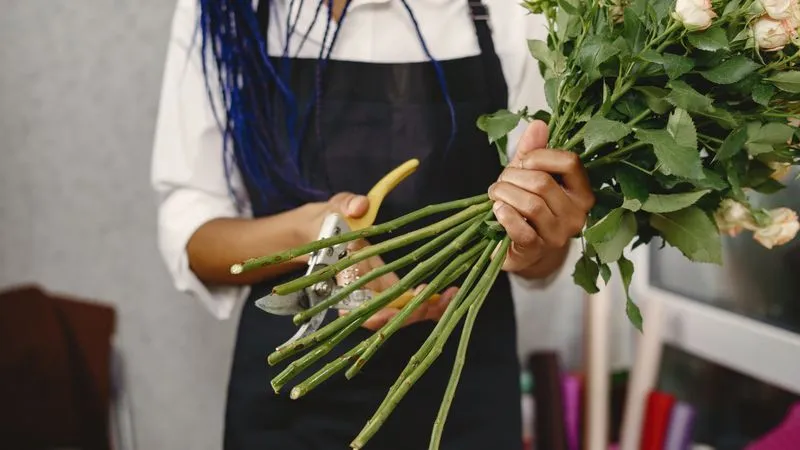
- Recut under water if you can. Hold the stems in a sink or bucket of room-temperature water and cut at least one inch from the bottom at a 45 degree angle with floral shears, a sharp knife or clean scissors.
- Strip the low leaves. Nothing green should sit below the water line, or it rots and shortens vase life. For roses, remove the thorns and the brown outer guard petals too.
- Let them drink. Put the buckets in a cool, not cold, room out of direct sun for at least 3 to 5 hours, and overnight when you can. Roses need at least 12 hours. Never put cut flowers in a refrigerator.
To slow opening before a weekend event, use cooler water and a cool, dark room. To speed it up for a Monday lobby refresh, use slightly warmer water, never hot. Once arranged, keep the flowers away from heat, drafts and direct sun, and change the water every 2 to 3 days or when it turns cloudy. If anything arrives damaged, call us within 24 hours with photos and we will refund or reship the damaged flowers.
What's the smartest next step for your business flowers?
Pick one event or one standing need, buy it wholesale with a clear stem plan, and protect a prep day on the calendar. Start small, then repeat what works.
A March 2026 Reddit thread on DIY wedding flowers shows what that trade looks like. One commenter's wholesale order covered a bridal bouquet, 6 bridesmaid bouquets and 16 table centerpieces for about $850, "pretty significantly cheaper" than hiring a florist. It also took about 6 hours between 6 people, from pickup to nearly done.
That's the deal in plain terms. Plan for both.
My advice is to start with the flowers your business needs again and again, like a monthly client dinner, a seasonal window display or the front desk vase, and build your first stem plan around that. Once your team has conditioned one order and watched it hold up, the next one goes faster, and the one after that feels routine. If you'd rather not build a stem plan from scratch, start with our wedding flower packs and curated collections, which group the varieties for you on a first order.
Summarize This Article With AI
Open this article in your preferred AI engine for an instant summary.
Frequently Asked Questions
What else do business buyers ask about bulk flowers?
Most questions come down to timing, shipping and care. Here are plain answers to the ones I hear most from planners, shop owners and office managers.
Do you ship bulk flowers to businesses anywhere in the US?
We ship premium fresh flowers anywhere in the continental United States, and fresh flowers and greens travel by FedEx Priority Overnight. We do not ship to Hawaii, Alaska, Puerto Rico or Canada. Supplies ship separately by FedEx Ground, so they may arrive on a different day.
How far ahead should I order flowers for a corporate event?
Order 2 to 3 weeks before your delivery date. Under 2 weeks, some items may be unavailable. You can place orders up to 120 days ahead, which helps if your event lands near a busy holiday.
Where do most wholesale flowers come from?
We buy from growers in Central America, South America, Europe and the United States, and each grower has to meet our standards for quality and consistency. Most of those flowers travel a long way before they reach you, which is why timing matters. Holiday weeks get crowded fast.
What does conditioning mean?
Conditioning is giving fresh stems a clean cut and a long drink before you arrange them. For example, you recut each stem at an angle, strip the leaves below the water line, and let the flowers rest in a cool, not cold, room.
How do I order or get help with a large order?
You can order online at bloomsbythebox.com, and an order placed before 2 PM Eastern on a weekday can usually be delivered as soon as the next day, depending on availability. For a big event or a recurring office order, call our Customer Service Team at 1-855-BUY-BLOOMS before you check out.
Written by
Joan
Owner, Blooms By The Box
Joan Wyndrum is a co-founder of Blooms By The Box, an online destination for fresh wholesale flowers and floral supplies.
Connect on LinkedIn