Quick Answer
Yes. For a DIY wedding, $5,000 is more than enough for flowers, because a full-service florist quote pays for design, labor, delivery and setup on top of the stems themselves.
Buying wholesale moves that work to you and your helpers. In exchange, the budget goes to flowers your guests actually see. Build a stem sheet, pick in-season varieties, and save tall pieces for a few tables, since table and piece counts drive florist prices.
Key Points
- The Knot's Real Weddings Study of nearly 11,000 couples puts the average flower bill at $2,800 and the upper quartile at $4,800 , so $5,000 already sits above it.
- A floral designer's 2024 tall centerpiece held $125.75 in wholesale flowers but would sell for $413.25 to $551 at the 3 to 4 times markup the designer called typical.
- Blooms By The Box sells bulk wedding varieties at an average of $3 to $4 per stem ; order 2 to 3 weeks before delivery, up to 120 days ahead.
Here's the puzzle this article solves. By national survey numbers, $5,000 is a generous wedding flower budget. By one floral designer's centerpiece math, it barely covers the tables. Both are true. The gap between them is design, labor and the florist's overhead.
Real couples talk about this more openly than glossy wedding pages do. In a 2025 r/Weddingsunder10k thread about planning a whole wedding for roughly $5K, one commenter put it plainly: "It's quite rare for people to afford a fully hired service kind of big ceremony." Another noted that vendors "always want to show off their most expensive tiers." Those photos quietly set your idea of what flowers should cost, long before you've priced a single stem.
I'm not going to tell you to skip flowers. Flowers are often the first thing couples are told to cut, and I think that advice aims at the wrong line. A DIY plan keeps the bouquets and the centerpieces and drops the design fee. With a few helpers and a clear list, that's a trade a lot of couples can make.
Inside, you'll find three things:
- The stem side of a quote: what one tall centerpiece costs in flowers next to what it sells for.
- The hidden hours: the prep, assembly and setup a florist charges for, and how to shrink them.
- The ordering path: how to build a stem sheet, choose in-season varieties and time your delivery.
Keep your guest list and a calculator nearby. By the end, you'll know how much of that $5,000 is flowers and how much is hands.
You've probably priced a florist already, or at least heard what a friend paid. So here's my first piece of advice: before you judge a $5,000 budget, ask what share of it would actually buy stems. The real question is what that money buys on each path.
A full-service florist quote bundles the stems together with design, labor, delivery, setup and breakdown. Many couples read $5,000 as the price of the flowers themselves. It isn't. Ask for a line-by-line quote so you can see which lines are flowers and which are service.
Couples have been rethinking scale, too. Helzberg Diamonds' 2022 survey of engaged couples, as summarized in a Library of Congress research guide, found growing interest in scaled-back and elopement-style weddings. A simpler wedding still deserves fresh, beautiful flowers. Doing them yourself is one way to keep the full look without paying for a design team to build it.
Here's how I'll walk you through it: what share of a florist quote is actually stems, what a DIY budget leaves on your plate, and how to order wholesale flowers directly. Don't worry, each step is simpler than it sounds.
First up, the flowers hiding inside a single centerpiece price.
How much of a florist quote is actually flowers?
Often less than couples expect, though quotes vary. Our average wholesale price is $3 to $4 per stem for bulk wedding varieties, so you can price the flower lines of any quote yourself.
Here's how to check any quote you already have in hand:
- Circle the lines that are only flowers: bouquets, boutonnieres, centerpieces.
- Estimate the stems each piece needs.
- Multiply that stem count by $3 to $4 and set it beside the line price.
The gap you see is the point. In 2024, one floral designer itemized a single tall centerpiece and found $125.75 in wholesale flowers: 7 hydrangea, 15 roses, a bunch of lisianthus, a bunch of spray roses, greens and filler.
Then comes markup. Markup is the multiple a business applies to its own cost to set the retail price. For example, a 3x markup means you pay three times what the piece cost to make. In 2024, that designer put typical florist markup at 3 to 4 times cost, so the same tall centerpiece would sell for $413.25 to $551 at that markup.
Couples sharing real quotes on Reddit's r/weddingplanning in 2023 saw the same shape. In that 2023 thread, one commenter's itemized florist list priced short centerpieces at $125 to $150 each, tall ones at $275, a bridal bouquet at $250 or $350, and bridesmaid bouquets at $80 each. A short centerpiece sold for roughly what the tall piece's flowers cost wholesale.
The national numbers line up too. The Knot Real Weddings Study found couples with 101 or more guests spent an average of $3,300 on flowers, and that figure covers bouquets, boutonnieres, wedding party flowers and centerpieces together.
On one designer's cost sheet, stems were the smaller part of the price; design time, labor, staff and studio overhead made up the rest, and that's fair pay for skilled work. Other cost guides put design, setup and delivery far lower, at 15 to 25 percent on top of flower costs, so check your own quote line by line.
What if you like wholesale prices but dread arranging every stem? You have two middle paths with us. Our wedding flower packs bundle loose bunches in quantities chosen for you, and you do the arranging. Our pre-made bouquets arrive individually sleeved and ready to display after a fresh trim of the stems, so a few tables can skip assembly. For your quote check, any line you could swap for a ready-made bouquet is a line where you're mostly paying for hands.
When you do the work yourself, every dollar goes to flowers and supplies. That's why I tell DIY couples to plan by stem count, not by piece price. Filler is where the count stretches furthest, and our guide to how much baby's breath you need shows how a few airy bunches fill out a centerpiece without adding focal blooms. Next comes the honest question: what does the same $5,000 actually buy on each path, side by side?
Is $5,000 a big wedding flower budget or a small one?
A Toronto couple was told to budget about $5,000 to decorate a 100-person wedding. After they sent photos of the tall centerpieces they wanted, the quote came back at $12,000.
The couple took the numbers to Reddit's wedding planning forum in June 2024. "There's no way people are spending this right?" they asked. According to the couple, the studio said the price depended mainly on how many tables and items there were. A floral designer in the thread replied with something more useful than sympathy: an itemized cost sheet for one tall centerpiece.
The flowers for that piece came to $125.75. Add a dish, a foam brick and a share of stands, clippers, knives and flower food, and the designer put their own cost at $137.75. Typical florist markup, the designer wrote, is three to four times cost.
On that sheet, materials are roughly a quarter to a third of what the client pays. According to the designer, the rest covers staff, website fees, studio overhead and expertise. "It's definitely a luxury service, but no one is setting out to rip you off."
Now multiply by the number of tables. At eight guests per table, 100 guests need at least 13 tables. The designer estimated $4,959 for centerpieces. At the low end of that markup, though, 13 tables come to $5,372.25, and at the high end they come to $7,163. That total doesn't include a single bouquet, boutonnière or ceremony piece. Another commenter said most florists they found had wedding minimums of $5,000 to $10,000.
Compare that with what couples actually spend. The Knot's Real Weddings Study surveyed nearly 11,000 couples. It puts the average flower bill at $2,800 and the median at $1,900.
By those figures, $5,000 is above even the upper quartile. Robyn Hunter of Songbird Floristry in Portland, Oregon, told The Knot that the national average "would cover personal flowers, a very simple statement piece for the ceremony and simple centerpieces." The survey also found that only 59% of couples hired a florist. Its averages therefore include weddings that never paid a florist's markup.
So how can $5,000 be top-quartile spending and still fall short of one florist's centerpieces for 100 guests? The two numbers measure different things. The survey records what couples paid. The designer's sheet shows what goes into a florist's price: a modest materials bill, multiplied by the people, the studio and the skill behind it. As a wholesale supplier to couples who do their own flowers, we have a stake in that difference. Still, the math above comes from a florist's own cost sheet. Measured that way, $5,000 is a generous budget for flowers and a tight one for full-service floristry.
When you do the work yourself, the labor lands on your own calendar. One commenter who bought from a local wholesaler spent 2 to 3 hours prepping flowers and 4 to 5 hours assembling them the day before the wedding, and recommended having three or four people. Hunter describes cleanup as taking "an inordinate amount of time." In another thread, a commenter described a bridal party assembling bouquets on the wedding morning because the bride worried they would wilt: "That was a big stress while also trying to get ready."
The obvious compromise, DIY bouquets with florist centerpieces, may not be available. In a 2023 thread, several commenters warned that florist contracts often ban outside flowers at the event. Mixing the two, one wrote, "is very likely to be a no go."
Before you settle on a number
- Count your guest tables before you set a number, because centerpiece costs climb table by table and can outrun everything else on the list.
- When a florist quote arrives, ask for materials as their own line, separate from design, delivery, setup and cleanup, so you can see how much of the total is flowers.
- Compare your number with The Knot's figures: anything above $4,800 already sits above the upper quartile of what couples spend.
- If you plan to combine DIY pieces with a florist's work, read the contract for an exclusivity clause before you order anything.
- If you go fully DIY, plan the prep, assembly and cleanup hours and line up helpers, so the work does not land on the wedding morning.
How we checked this
We used The Knot's survey of nearly 11,000 couples, which includes comments from working florists, and three r/weddingplanning threads from 2018, 2023 and 2024. No figures in this section come from our own data. The Reddit posts are anonymous and unverified, and they describe individual experiences rather than patterns. The designer did not say where they work. The Toronto thread does not state a currency. The designer's $4,959 estimate equals 12 tables at the low-end price, so we recalculated for the 13 tables the designer described. The Knot runs a vendor marketplace, and we sell flowers to couples who arrange their own, so both of us have a stake. Still unknown: how typical a 3x to 4x markup is across the industry, and what a fully priced DIY stem sheet for a large wedding totals.
- The Knot, average cost of wedding flowers, updated May 6, 2026.
- r/weddingplanning, thread asking whether a $5,000 minimum is unavoidable for a 100-guest wedding, including a floral designer's itemized centerpiece costs, June 25, 2024.
- r/weddingplanning, thread on what a $2,000 flower budget buys, May 17, 2023.
- r/weddingplanning, thread on DIY bouquets and buying flowers in bulk, September 3, 2018.
What does a DIY flower budget not pay for?
Your time. Plan for helpers, buckets, clippers and a free evening before the wedding, because no stem price covers that part of the job.
A florist's fee covers far more than picking flowers. Here's what it quietly pays for, in plain words:
- Setup labor: hauling, placing and fluffing every piece at the venue, often on a tight clock.
- Installations: big structural pieces like an arch, a ceiling hang or a wrapped beam, plus the ladders and mechanics to hang them.
- Design skill: knowing how full a piece must be to look right, and building it so it holds all evening.
One Tennessee florist, writing in 2020 about her own pricing, listed set-up labor, installations and special equipment among the main cost drivers. She also pointed out that flowers and food are the only two perishable wedding items, so the work squeezes into the wedding week, usually the day or night before. That timing is the real cost of DIY.
How much time are we talking about? A couple posting on r/weddingplanning in 2018 reported 2 to 3 hours of flower prep on delivery day and 4 to 5 hours of assembly the day before, and recommended at least 3 to 4 hands.
The money is there. So ask yourself who will be holding the clippers that night. That's the trade.
Budget weddings show the same pattern from the other direction. In a 2025 r/Weddingsunder10k thread, one commenter planning about $5K for 110 guests leaned on college students for setup and teardown, and credited "getting lucky and asking for help." Another put it plainly: "Its a lot more work but you have to find what really matters to you and what you can go without."
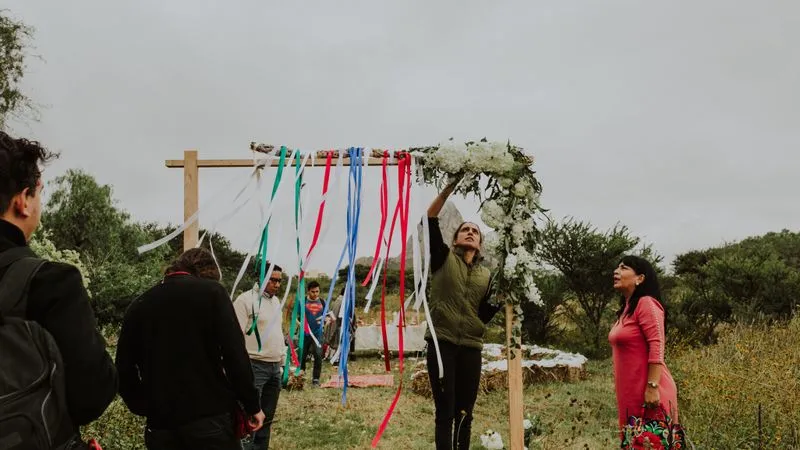
Installations are where that labor gets pricey. A 2021 price guide from Bark, a marketplace that lists wedding florists, put its top package tier, with chandeliers, flower balls, garlands and archways, at $2,500 to $5,000+. Bark's own pitch was that hiring a florist is worth it, because building arrangements is "not as easy as it looks." Read that as the claim of a site that sells florist services. Still, the shape is useful. An archway is mostly mechanics: a frame, ladders, wire and a crew who know how to hang stems so they stay put. For a DIY wedding, it's the piece most likely to eat a whole evening. A garland shows the difference clearly. Laying one down a table is quick work; hanging one overhead takes a ladder, a second pair of hands and a way to attach it.
I'd rather you see this clearly now than at 11 p.m. the night before. Three choices shrink the workload the most:
- Skip the big installation and let a simple arbor or the venue itself carry the ceremony.
- Choose low, loose centerpieces over tall ones, which need far more stems and mechanics.
- Move ceremony pieces to the reception so you build once and use twice.
Picking forgiving, full-headed blooms helps too. Our collection of wholesale garden wedding flowers leans on varieties like hydrangea and spray roses that fill space fast, so each piece takes fewer stems and fewer minutes. And a small test run a few weeks out turns guesswork into a stem count you trust, which is exactly where the planning starts.
Where can you buy wholesale flowers online for a DIY wedding?
Order directly at wholesale pricing from a supplier that sells to the public, so your money pays for stems and greenery rather than a florist's design and labor hours.
Cutting flowers is a classic money tip. A 2022 Helzberg Diamonds survey of more than 1,000 engaged couples, cited in a Library of Congress research guide, put the average wedding cost at up to $33,204 and named cutting flowers as one way to save. I'd turn that advice around. Contrary to that tip, the line worth trimming is the labor, not the flowers.
Think of it this way. When you buy at wholesale pricing, more of each dollar lands on something your guests actually see. Before you order from any site, check what past buyers say: Blooms By The Box holds a 4.7/5 average across 11,700+ verified Shopper Approved reviews, with 75% five-star.
Here's how to order in three steps:
- Build a stem sheet. A stem sheet is simply a list of every piece you plan to make, with the flowers each one needs written beside it. For example, one line reads "bridal bouquet" with its roses, spray roses and greenery, and the next line covers a single centerpiece, which you then multiply by your table count.
- Pick varieties that are in season for your date. Roses, hydrangea and lisianthus are available all year, while dahlias are May to September only and peonies run March to July. Choosing in-season stems keeps your sheet realistic from the first draft.
- Order directly, and on time. Place your order 2 to 3 weeks before your delivery date (you can order up to 120 days ahead), and schedule delivery about 2 days before the event so the flowers have time to drink and open.
Selection matters as much as price. We carry an extensive selection of bulk flowers and greenery, so one order can cover the bouquets, the centerpieces and the filler that ties them together. That means fewer separate shopping trips for you and fewer chances for colors that almost match but don't.
Don't worry about paperwork, either. You don't need a reseller license to place an order.
One more early choice saves real hours: how your arrangements hold their shape. If you're weighing foam against wire for your tables, our guide on why chicken wire can't replace floral foam in every design walks through which pieces need which mechanics. Settle that before the boxes arrive, and every helper at your assembly table works faster on the day it counts.
So what should you do with your $5,000?
Spend it on stems, supplies and a few willing helpers, and treat any leftover as yours to keep, because a DIY plan doesn't need the full florist budget to look generous.
Florist minimums can swallow a $5,000 budget on their own. In 2024, couples comparing quotes online reported that most florists they contacted set $5,000 to $10,000 minimums. For where 2026 prices are heading, see our look at why DIY flower budgets beat rising 2026 florist quotes.
Think of a restaurant meal next to the same dish cooked at home. The ingredients were never the pricey part. The kitchen was.
Your own tables can stretch further, too. A 2025 sustainable wedding newsletter by Sasha suggests thrifted, borrowed or repurposed vessels, which add character "without using more flowers." I love that idea. Every dollar it saves goes straight back into fresh stems.
Before you commit the money, check how our order rules shape it. A few details change the math:
- The $99 minimum: every order must total at least $99, and an order with fresh-cut flowers needs at least $99 of fresh-cut flowers, not counting petals. A small test run a few weeks out still has to clear that bar, so plan it as a real centerpiece or two.
- Shipping: flower orders over $199 ship free for Tuesday to Friday delivery. Saturday delivery adds a $20 surcharge and isn't offered in every zip code. Supplies such as containers and freeze-dried petals ship separately by ground, carry their own shipping charges and can arrive before the flowers.
- Bunch counts: most bunches hold 10 stems, but the count varies, so read each product's stems per bunch before you turn your stem sheet into a cart.
- Changes: you can change or cancel most items up to 14 days before delivery. Changes cost nothing, while cancellations may carry a 10% restocking fee, so settle your guest count and table plan before that date.
- Substitutions: fresh flowers depend on the harvest, so we may substitute a type, size or color as late as the day before delivery, and any reduction in value is credited back. A palette with some give in it protects the look.
Plan arrival day around water, too. Flowers travel dry, so they can look limp when the box opens. They perk up after at least three to five hours in water and do best left overnight, and roses need at least 12 hours before you arrange them. Gather enough clean buckets to hold every stem without crowding. If anything arrives damaged, call us within 24 hours and send photos so we can refund or reship it.
So start your stem sheet tonight, and price it before you call a single florist.
Frequently Asked Questions
What else do people ask about a $5,000 wedding flower budget?
Most follow-up questions cover delivery, which flowers last, care on arrival and aisle petals, so here are clear answers to each one.
Can I get wholesale wedding flowers delivered to my state?
Yes, if you live in the continental United States. We ship anywhere in the continental US, but not to Hawaii, Alaska, Puerto Rico or Canada. Fresh flowers and greens travel by FedEx Priority Overnight.
Which flowers give a DIY budget the most time on the table?
Vase life is how many days a cut flower stays fresh in water. Lilies are a strong pick: our lily pages give 10 to 12 days, and they're available all year.
What should I do when my flower boxes arrive?
Unbox and hydrate right away. Remove the sleeves, strip leaves below the water line, and recut each stem at least one inch at a 45 degree angle into room-temperature water. Let them drink in a cool, not cold, room. Never put them in a refrigerator.
Should I use fresh or freeze-dried petals for the aisle?
I'd choose freeze-dried petals, which are real petals dried to hold their shape. You can order them ahead, they won't wilt, and the color stays consistent. They ship separately by FedEx Ground.
What if my question isn't answered here?
Call our Customer Service Team at 1-855-BUY-BLOOMS for personal assistance with your order.
Written by
Joan
Owner, Blooms By The Box
Joan Wyndrum is a co-founder of Blooms By The Box, an online destination for fresh wholesale flowers and floral supplies.
Connect on LinkedIn