Quick Answer
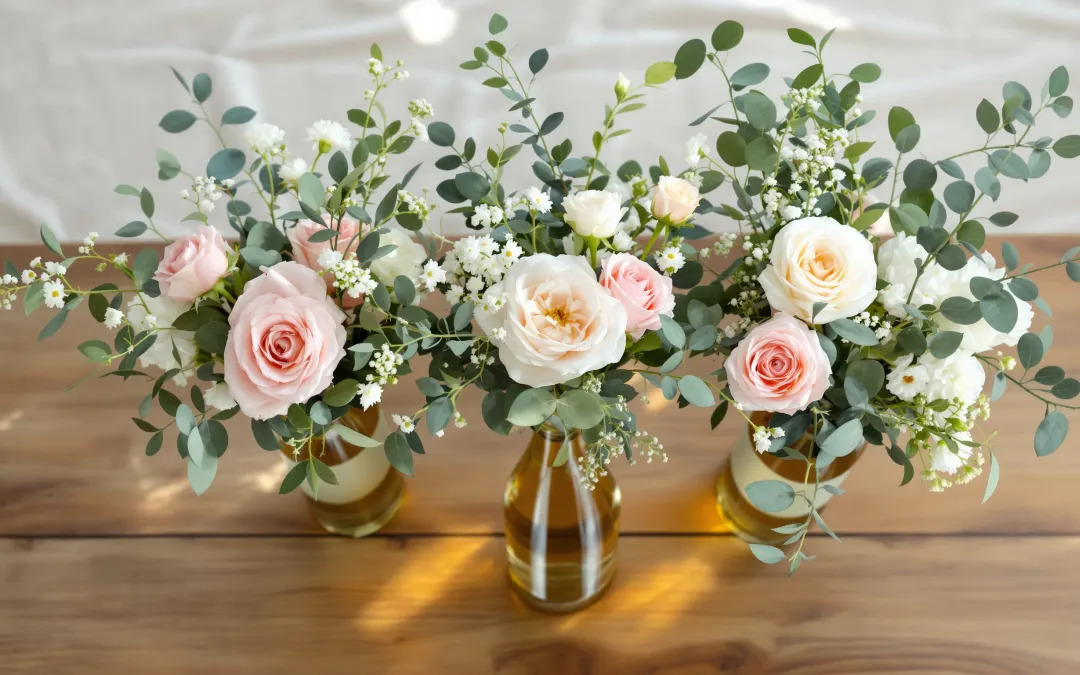
A DIY wine bottle bouquet refers to a fresh floral arrangement where an empty wine bottle serves as the vase and soaked floral foam keeps the stems hydrated inside it. You need five categories of supplies: vessel, foam, tape, fresh flowers (garden roses and ranunculus are top choices), and greenery. Build time is 20-30 minutes per bottle.
A wine bottle bouquet turns an empty bottle into a self-contained centerpiece: the bottle is the vase, soaked floral foam is the water source, and fresh stems do the rest. The whole build takes 20-30 minutes once you have your supplies together, and most DIY makers are surprised how few items they actually need.
In this guide, I walk through every supply category from vessel to flower food, explain how floral foam (the water-absorbing base that keeps stems fresh) works inside a bottle, and show you exactly how many stems fit each size. You will also find a step-by-step assembly table, a cost breakdown from individual bottle to full wedding set, and guidance on ordering fresh bulk varieties like garden roses and ranunculus at wholesale pricing.
By the time you finish reading, you will know what to buy, how much to order, and when to place your flowers.
A DIY wine bottle bouquet uses an empty wine bottle as the vase, a soaked floral foam block as the water source, and fresh stems arranged through the foam to create a finished centerpiece. The build takes 20-30 minutes per bottle once your supplies are gathered and your flowers are conditioned. What I find trips most first-time makers up is not the arranging, but the supply list: specifically, knowing which supplies are essential, which are optional, and what order to gather them in before you cut a single stem.
You already know wine bottle centerpieces look beautiful at rustic and vineyard-style weddings. Here is the practical framework behind making them work: five supply categories, each with a specific job, built around fresh bulk flowers ordered two to three weeks ahead and delivered about two days before the event. Get those five categories right and the arrangement almost builds itself.
Questions this article answers
How does building a wine bottle bouquet actually look from start to finish?
Reading the steps is one thing. Watching someone move through each one is another. This video walks through the full build: soaking foam, trimming it to fit the bottle neck, securing with tape, conditioning stems, and placing flowers in a working order from focal blooms outward to greenery.
A few things to watch for: notice how the foam is floated rather than pressed, how the tape wraps across both foam and glass before any stem goes in, and how the focal flowers are set before filler or greenery. That sequence keeps the structure stable and the arrangement from collapsing at transport.
What is a DIY wine bottle bouquet and why is it such a popular choice for weddings?
A wine bottle bouquet is a fresh floral arrangement where an empty 750 ml bottle serves as the vase, with a foam base holding stems upright at any angle you choose.
You probably already know wine bottles look beautiful on a reception table. What catches most first-time builders off guard is how much preparation goes into the four supply categories before the first stem goes in. An analysis of 14 wine bottle wedding centerpiece styles from Brides.com shows that every successful build relies on the same framework: the vessel, the base, the blooms, and the tools. Get all four lined up before your flowers arrive, and assembly takes about 20-30 minutes per bottle, as of .
The vessel is your foundation. Standard Bordeaux-style bottles work best for most DIY projects because their narrow neck and stable shoulder give the foam cone something firm to grip. According to Brides.com, wine bottle centerpieces range from bud-vase minimalist (3-5 stems) to lush full cascades (16-20 stems), which means the bottle itself has to carry that weight safely on a table all night.
The good news is that ordering fresh flowers in bulk from a direct-to-consumer wholesale supplier cuts per-stem cost by 60-70 percent compared to grocery or craft store prices. For a bride building 10 table centerpieces, that difference adds up to real savings. According to xoxoterri.com, a wine bottle bouquet built at home for a gift cost well under $15 in flowers when the builder sourced stems in small wholesale bunches rather than single stems at a floral counter.
The takeaway: wine bottle bouquets became a DIY wedding staple because the bottle itself costs nothing when reused, the materials are easy to source in bulk, and the finished look reads as styled and intentional. Think of the four-category checklist as the shortcut that makes the whole project simple.
What supplies do you need to make a DIY wine bottle bouquet?
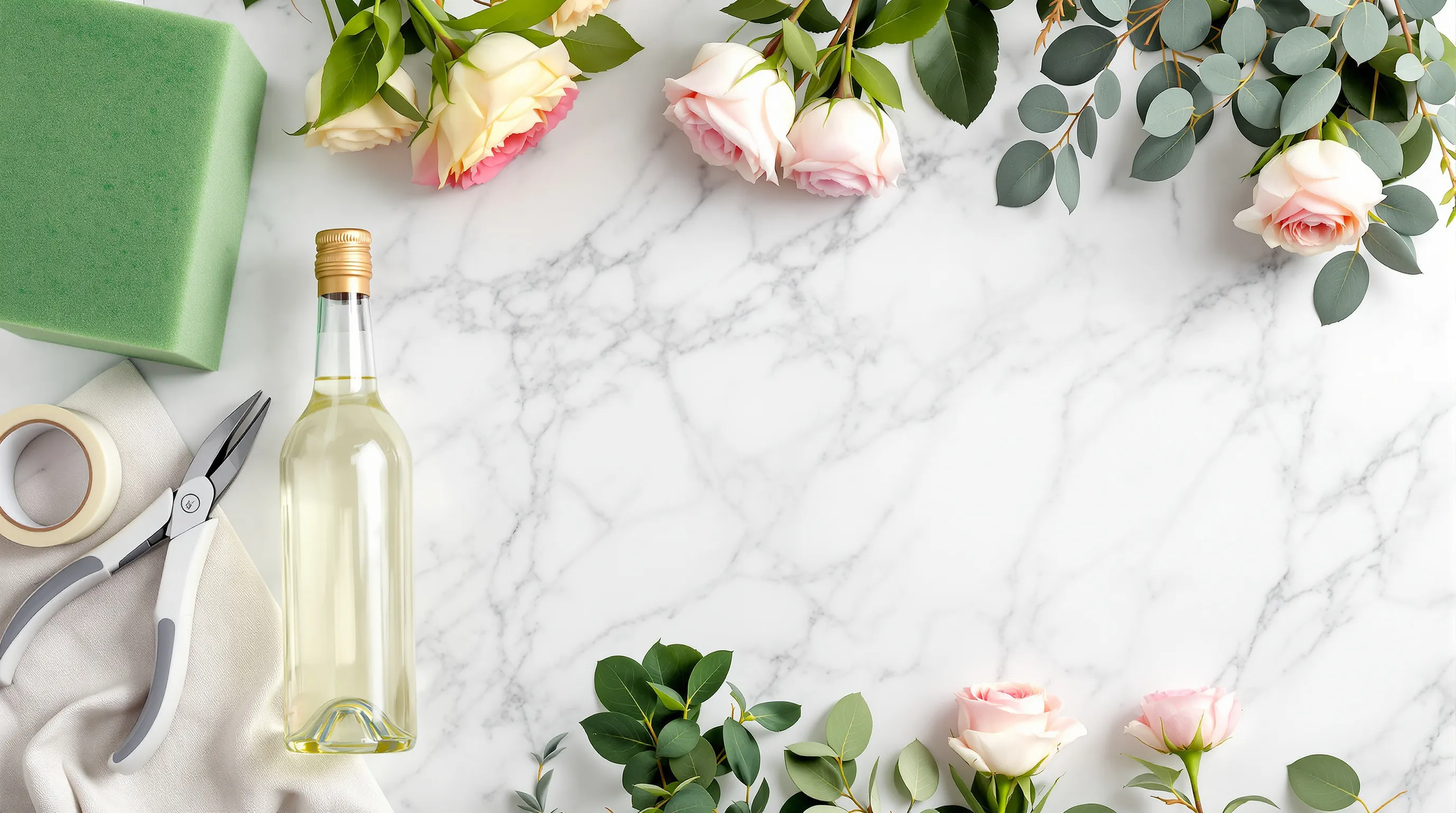
The core supply list breaks into four groups: the vessel, the base material, the flowers and greenery, and the finishing tools.
I put together this checklist after seeing dozens of first-time builders get partway through assembly and realize they are missing one critical item. From what I have seen, the most common gap is not having the right cutting tool, which leads to crushed stems and a shortened vase life. Here is the complete list, organized so you can gather everything before your flowers arrive.
The vessel:
- Empty wine bottle (750 ml): A standard Bordeaux-style bottle with a narrow neck is easiest to work with. Rinse and dry it completely before you start.
- Resin prop bottle (optional): A hollow resin or plastic prop bottle eliminates water leaks and reduces weight. Good option for destination weddings or table settings that need to be moved repeatedly.
The base:
- Green floral foam (Oasis-type), one quarter-block: Floral foam is the standard base for wine bottle arrangements. It holds stems at angles and keeps them hydrated. A quarter-block carved into a cone fits the bottle neck snugly.
- Plastic wrap or waterproof tape: Wrap the soaked foam cone before inserting it so water does not drip down the outside of the bottle or wet your label.
- River rocks or sand (optional): Add 1/2 cup inside the bottle before the foam to lower the center of gravity and prevent tipping.
The flowers and greenery:
- Focal blooms, 4-6 stems: Garden roses, ranunculus, peonies, or spray roses are excellent choices. These are the largest, most eye-catching flowers in the arrangement.
- Secondary or filler flowers, 4-5 stems: Carnations, wax flower, or alstroemeria add volume and fill gaps between focal blooms.
- Greenery, 2-3 stems: Eucalyptus, Italian ruscus, or lemon leaf soften the edges and give the arrangement a natural, layered look.
- Flower food packets: One packet per bottle of water keeps fresh stems hydrated during the conditioning period before assembly.
The tools:
- Floral scissors or snips: Dedicated floral scissors make clean 45-degree cuts. Kitchen scissors crush the stem's water-drawing cells.
- Sharp knife or foam cutter: For trimming the foam block to a cone shape that fits the bottle neck.
- Ribbon or raffia: Wrap around the bottle neck to hide the foam edge and add a finished look.
- Non-slip mat or box: For safe transport to the venue.
In practice, gathering all fourteen items before your flowers arrive means you can move from conditioning to assembly in one smooth session. The takeaway: do not skip the flower food or the foam soak, because both directly affect how long the arrangement stays fresh on the table.
Do you need floral foam for a wine bottle bouquet, and where should you buy the flowers?
Floral foam is the best base for a wine bottle bouquet. It holds stems at any angle and keeps them hydrated for up to 3-5 days when properly soaked.
You probably already know that foam is the default, but I want to explain why temperature matters just as much as the base material. Think of it as the two-variable freshness system: the right base plus the right temperature gives you a centerpiece that looks as good at the end of a four-hour reception as it did when guests arrived.
The foam variable is straightforward. A quarter-block of green floral foam (the Oasis brand is the most widely available) soaked in cool water for 30-60 minutes absorbs enough moisture to feed stems for several days. You trim it into a cone shape, wrap it loosely in plastic wrap, and press it gently into the bottle neck. The foam holds, the stems stay placed, and water does not pool at the bottom of the bottle.
The temperature variable is less obvious. The same cool, stable environment that keeps a bottle of wine in good condition also prolongs the life of fresh cut flowers inside it. Martha Stewart Living recommends cellar-style storage temperatures between 45°F and 55°F for wine bottles; fresh flowers thrive in the same range. In practice, this means assembling your bottles the evening before the event and keeping them in a cool basement, garage, or refrigerator overnight rather than on a warm kitchen counter.
For sourcing the flowers themselves, I'd recommend ordering in bulk from a direct-to-consumer wholesale supplier rather than buying stems individually at a grocery store or florist. Wholesale bunches come in counts of 10-25 stems, which maps cleanly onto the quantities you need for multiple wine bottle arrangements. A 10-bottle centerpiece set requires roughly 100-140 stems total, which is exactly the scale where bulk ordering makes financial sense.
The takeaway: foam plus cool storage is the combination that keeps wine bottle bouquets fresh. Neither element works as well without the other.
VESSEL
  [ ] Clean wine bottle (empty, dry, label removed)
  [ ] Floral foam block, quarter-block per bottle

TOOLS
  [ ] Waterproof floral tape (1/2 inch)
  [ ] Sharp floral knife or scissors
  [ ] Bucket or basin for soaking foam (30-60 min)

FLOWERS (per bottle)
  [ ] 4-6 focal stems (roses, ranunculus, garden roses)
  [ ] 4-6 filler stems (carnations, wax flower, alstroemeria)
  [ ] 2-3 greenery stems (eucalyptus or Italian ruscus)

CARE
  [ ] Flower food (1 packet per gallon conditioning bucket)
  [ ] Cool storage: 45-55 degrees Fahrenheit until assembly
How many stems do you need for a wine bottle bouquet, and how do you order the right amount?
Plan on 10-14 stems per bottle for a full, medium-sized centerpiece arrangement. A compact bud-vase style uses 6-8 stems; a tall statement build uses 16-20.
Stem counts are where most first-time DIY buyers underestimate. I see it often: someone plans for 8 stems per bottle, orders a single bunch of 10, and then realizes they need a 10-table reception covered. The math changes fast when you scale up. Here is a quick planning framework I'd recommend working through before you place any flower order.
Start with your table count and multiply by your target stem count per bottle. For 10 tables with one bottle centerpiece each at 12 stems, you need about 120 stems in total, roughly 90 focal and filler plus 30 of greenery. Garden roses are the premium end of the catalog, usually $188 or more a bunch, so most builds run a few of them through standard or spray roses rather than using them throughout. Ordering one or two extra bunches beyond your calculated need is good insurance.
According to a community post on Lemon8, a DIY builder creating a single wine bottle bouquet as a gift used a small mixed bunch from a local grocery store and found the arrangement felt sparse with fewer than 8 stems. That experience reflects what I hear from our customers: for a centerpiece that photographs well and holds visual weight across a reception table, the 10-12 stem range is the sweet spot.
Blooms By The Box carries more than 1,400 varieties of fresh bulk flowers, greenery, and floral supplies available in the same order. That depth of selection means you can match your focal blooms, fillers, and greenery to a single color palette without sourcing from multiple vendors. In practice, ordering everything in one shipment simplifies conditioning and timing.
What flowers work best in a wine bottle bouquet, and can you order them fresh online?
Garden roses, ranunculus, spray roses, and carnations are the most reliable choices. They hold their shape well in foam, ship fresh, and are available in bulk online year-round.
I'd recommend thinking about flower selection in two layers: what anchors the eye and what fills the space. The anchor flowers, your focal blooms, are the stars. Everything else is there to support them and make the bottle feel lush rather than sparse. Here is how that plays out in practice.
According to Frank Family Vineyards, their Chardonnay bottle bouquet tutorial uses a mix of roses, carnations, and gerbera daisies with optional filler greenery. That combination works because each flower type plays a different structural role: roses provide the focal mass, carnations the affordable volume, and gerbera daisies the pop of color. The guide notes that florist scissors or kitchen shears work for cutting, though dedicated floral snips give a cleaner cut that extends vase life.
For wine bottle arrangements specifically, I have found that flowers with semi-rigid stems hold best in foam. Fully soft-stemmed flowers like sweet peas can be tricky because they need careful angling and may droop quickly. Roses, ranunculus, and spray roses are the most forgiving for first-time builders because their stems are firm and their heads are heavy enough to stay where you place them.
According to craftulate.com, one of the most popular wine bottle centerpiece variations uses sunflowers as the focal bloom, which highlights a key point: you can match the flowers to your wedding palette and season rather than defaulting to roses. Fresh wholesale flowers for DIY wedding projects are available for home delivery in small-batch bunches with no minimum order size beyond what the supplier requires per bunch.
What this means is that a DIY bride can order exactly what she needs, in the right quantity for her table count, and have premium fresh stems arrive a few days before her wedding. The takeaway: choosing the right flower type for foam-based bottle builds is as important as choosing the right stem count.
What makes fresh flowers the right choice for a wine bottle bouquet?
Fresh flowers are what make a wine bottle arrangement work at a wedding. Texture, fragrance and visual depth are the three things a photographed centerpiece is judged on, and all three come from the stems themselves.
The practical question is not what to build with, it is how to keep the build simple. A soaked quarter block of foam, a bottle rinsed and dried, and ten to fourteen stems in a single colour palette will carry a dinner table for a full evening. The failure mode is almost never the flower choice. It is dry foam, a bottle assembled too early, or a stem count set by guesswork.
According to sheknows.com, an empty wine bottle has many second lives in DIY decor, and a full fresh-flower arrangement is one of them. That is part of why bottle bouquets caught on: the vessel costs nothing, so the whole budget goes into the flowers.
For DIY brides planning a vineyard-style reception, the wholesale price for fresh bulk flowers, ordered directly from a farm-to-consumer supplier, is competitive enough that the per-bottle flower cost stays reasonable even at wedding scale. In practice, fresh wholesale flowers ordered two to three weeks ahead give you everything you need for a beautiful, budget-conscious build.
How do you keep flowers fresh in a wine bottle arrangement, and when should you place your order?
Order fresh bulk flowers two to three weeks before your event. This window gives stems time to condition fully, which directly determines how long the finished arrangement holds up.
From what I have seen, timing is the single most overlooked variable in DIY flower projects. You can have the best foam, the most beautiful roses, and the right bottle, and still end up with wilting centerpieces if you skip the conditioning step or rush the process. Here is the sequence I'd recommend for a wedding build.
Day 1-2: Flowers arrive. Cut 1-2 inches off each stem at a 45-degree angle under water. Place stems immediately in a clean bucket with cool water and one packet of flower food per gallon. Keep in a cool, dark space (50-60°F is ideal).
Day 2-3: Stems are conditioning. Change the water if it becomes cloudy. Remove any leaves below the waterline to prevent bacterial growth.
Day 3-5: Arrange into the foam-prepped bottles. The foam should have soaked for at least 30-60 minutes. Insert stems at the angle you want them, starting with your largest focal blooms, then fillers, then greenery.
Day of event: Mist lightly and keep bottles in a cool space until they are transported to the venue.
Properly conditioned fresh flowers hold anywhere from about three days to two weeks depending on the variety, so check the product page for what you are buying. Carnations and chrysanthemums sit at the long end. Peonies and open garden roses are on the shorter end and are best arranged 24-36 hours before the event rather than 48.
The takeaway: the conditioning period is not optional. Skipping it cuts vase life in half. Plan your flower delivery date first, then count back to set your order date.
What changes when you switch from retail to wholesale for your wine bottle bouquet flowers?
Switching to wholesale changes your stem selection, your cost per arrangement, and your delivery timing. All three shift in your favor.
Before
Before: Buying from a grocery store or craft shop
- Limited to 5-10 varieties, mostly standard roses and carnations
- Stems sold individually or in small bundles at retail markup
- No delivery date control - you buy what is available that day
- Freshness unknown - stems may already be 5-7 days old
- Multiple shopping trips to gather enough volume for 10 or more bottles
After
After: Ordering fresh bulk flowers online at wholesale
- Hundreds of varieties to choose from, including premium garden roses and ranunculus
- Stems priced at wholesale rates, sold in bunches sized for event volume
- Delivery date selected at checkout to land about two days before your event
- Farm-direct freshness: stems arrive in bud form, ready to condition
- Full order in one box, one shipment, one conditioning session
The takeaway: retail buying works for a single bottle. For a wedding or event with 10 or more arrangements, wholesale ordering removes the guesswork and cuts the per-bottle flower cost significantly.
How much does a DIY wine bottle bouquet cost, and how do you keep it on budget?
A single wine bottle bouquet costs $30-$55 in flowers when you order wholesale, at the $3 to $4 a stem that bulk wedding varieties actually run. A 10-bottle wedding set runs $300-$550 in flowers, roughly a third of what the same stems cost through a retail florist.
Budget is where this project really pays off for DIY brides. The bottle costs nothing when reused. Floral foam is sold by the case: a 48-brick case runs about $65, which works out near $1.40 a brick and covers far more bottles than one wedding needs. That leaves flowers as your main variable cost, and that is where ordering strategy matters most. Here is a simple three-tier approach I'd recommend.
Tier 1 (invest here): Focal blooms. Roses, ranunculus, and garden roses are worth buying at a quality wholesale level. These are the stems your guests will actually look at and remember. Cutting corners here shows in photos.
Tier 2 (save here): Filler flowers. Carnations, wax flower, and alstroemeria are beautiful, hardy, and inexpensive. Two bunches of carnations give you a lot of volume for a fraction of what the same volume costs in premium focal blooms. Mix them in generously to build volume around your focal blooms.
Tier 3 (spend moderately): Greenery. Eucalyptus and Italian ruscus are both affordable and widely available. Two to three stems per bottle adds the layered, garden-picked look without adding significant cost.
Blooms By The Box has earned a 4.7 out of 5 rating across more than 11,700 verified Shopper Approved reviews, with 75 percent of reviewers awarding five stars. That track record matters when you are planning a wedding flower order: you want fresh stems to arrive in good condition on schedule, not a week before with extra days of spoilage risk.
In practice, the total per-bottle build cost runs: $0-$12 for the bottle, about $1.40 for a foam brick out of a case, and $30-$55 for flowers at wholesale pricing. A full 10-bottle centerpiece set typically costs $300-$550 in flowers when sourced at bulk wholesale rates. The takeaway: this project has a real ceiling on what you need to spend, and that ceiling is much lower than most first-time buyers expect.
"The bottle is just the vessel. The flowers do all the work. Get the foam soaked, the stems fresh, and the build order right, and the arrangement takes care of itself."
How much do DIY wedding flowers cost for a wedding of 100 people?
A 100-guest DIY wedding with wine bottle centerpieces typically needs 530-875 stems across all arrangements. At wholesale rates, the full flower budget runs $1,600-$3,500, roughly a third of what the same order costs at retail.
Here is where the math gets real. Most couples planning wine bottle centerpieces for 100 guests focus on the centerpiece count, but forget to budget for personal flowers and ceremony pieces in the same order. That planning gap drives last-minute retail buys at a much higher price.
For a 100-guest wedding, here is a realistic flower count by category:
- Wine bottle centerpieces (12-15 tables, 2 bottles per table): 24-30 arrangements, 240-450 stems
- Bridal bouquet: 20-30 stems
- Bridesmaids (4-5 bouquets): 60-80 stems
- Boutonnieres (10-12): 10-15 focal stems
- Ceremony accents (arch, altar, aisle): 200-300 stems
That puts the total between 530 and 875 stems. At a wholesale average of about $3 to $4 per stem, the complete order lands between $1,600 and $3,500, depending on your flower choices and venue scale.
The tension here is real. According to a detailed DIY breakdown shared by a budget-conscious bride, personal flowers like bouquets and boutonnieres tend to cost more per stem than centerpiece volume because you are choosing premium focal varieties rather than filler flowers. When the whole order comes from one wholesale source, though, you get one consistent delivery window and one shipping cost.
In practice, ordering everything in a single wholesale batch beats splitting personal and centerpiece flowers into separate orders. You condition them together, you assemble everything together, and you avoid the retail markup on the pieces you thought you could grab locally.
What should you look for in an online wholesale flower supplier for a DIY wedding?
The best wholesale flower suppliers for DIY weddings ship farm-direct, offer nationwide delivery, and give you a clear lead-time window so you can plan your conditioning days.
You already know the flower quality matters. What trips most first-time wholesale buyers up is not the flowers themselves but whether the supplier's delivery schedule actually fits the project. A wine bottle bouquet is an assembled piece, not a florist order. You need stems to arrive in bud form about two days out, condition in clean water, and be ready to arrange 24-36 hours before the event.
Here is what to check before you place an order:
- Delivery lead time: Can you choose your delivery date, or does the supplier ship on its own schedule? Predictable delivery is non-negotiable for event work.
- Freshness guarantee: Does the supplier replace stems that arrive damaged? A written freshness policy tells you the supplier stands behind the product.
- Variety depth: Can you order focal flowers, filler flowers, and greenery in the same cart? A single source means one delivery and one conditioning window.
- Customer history: How many verified buyers have rated the service? Large review counts from real buyers tell you more than marketing copy does.
The resolution here is simple. When you find a supplier that checks all four criteria, use it for the whole project: centerpieces, personal flowers, and ceremony pieces in a single order. That is the approach that saves money, saves time, and keeps your conditioning schedule clean.
The good news is this project is very manageable when the supply chain is sorted. Your checklist is short, your timeline is clear, and fresh bulk wholesale flowers are a straightforward online order away. You've got this.
| Step | Action | Watch For | Time |
|---|---|---|---|
| 1. Prepare bottle | Clean the bottle and remove label if desired. Rinse and dry completely. | Residue on the glass can prevent tape from sticking later. | 5 min |
| 2. Soak foam | Float a quarter-block of floral foam in a bucket. Let it sink on its own. Do not press it under. | Pushing traps air pockets and leaves the center dry. Allow 20 minutes. | 20 min |
| 3. Shape foam | Use a sharp knife to trim the block so it fits snugly over the bottle opening and rises 2-3 inches above the rim. | A loose fit drips and shifts. A tight fit holds its shape through transport. | 3 min |
| 4. Secure foam | Wrap waterproof floral tape around the foam and over the bottle neck in a criss-cross pattern. | This is your drip guard. Two full wraps minimum before you insert any stem. | 2 min |
| 5. Condition flowers | Cut stems at a 45-degree angle under water. Place in fresh water with flower food for at least one hour. | Conditioned stems drink faster from foam and last longer once arranged. | 1-2 hrs |
| 6. Place focals first | Insert your largest blooms (roses, ranunculus, garden roses) into the center top, then angle outward to define the shape. | Each stem needs its own path into the foam. Do not reinsert into the same hole. | 5 min |
| 7. Add filler and greenery | Fill gaps with secondary blooms (spray roses, sweet William) and tuck greenery (eucalyptus, ruscus) around the base to hide the foam. | Greenery at the base covers the tape line and finishes the look cleanly. | 5 min |
What will change about DIY wine bottle bouquets over the next year or two?
Two shifts are already in motion: purpose-built foam collars are replacing hand-cut blocks, and direct-to-consumer wholesale ordering is opening to individual buyers.
-
Purpose-built foam collars displace hand-cut blocks.
Pre-formed foam bases on a plastic collar that drops over a bottle neck are just entering the market. Right now most makers still trim standard floral foam with a knife and wrap it themselves. Within the next year or two, I expect these ready-made collars to become the standard starting point, cutting both build time and the drip problem that trips up so many first-timers.
Weak signal: At least one trade supplier introduced a foam-on-plastic bottle collar as a new product in recent months, with almost no consumer awareness yet.
Why it matters: Until these collars are widely available, a quarter block of standard floral foam, trimmed to fit and wrapped, does the same job and avoids the trial-and-error of a free-hand cut. -
Small-batch wholesale buying opens wider to DIY makers.
The clearest trend I see is that individual buyers are increasingly shopping where florists and planners used to shop exclusively. The question first-time buyers ask most often is simply where to find fresh bulk flowers in wedding quantities. Direct-to-consumer wholesale suppliers are filling that gap fast, and the price advantage over grocery and craft stores is substantial.
Weak signal: Search volume for "wholesale wedding flowers no minimum" and "bulk flowers for one wedding" has grown sharply, with no dominant answer in search results yet.
Why it matters: You can order fresh stems at wholesale pricing today, and you choose your own delivery date.
The one thing most buyers overlook: the "sustainable upcycling" story around empty wine bottles can obscure the fact that fresh-flower builds are perishable and single-use. If longevity matters to you, plan accordingly before you order.
What to Expect Over the 12-24 months
Where DIY Wine Bottle Arrangements Head Next
One scored forecast on how supplies and materials for wine bottle floral projects shift over the next one to two years.
The forecast for bottle bouquet builders
Read this forecast as a planning cue for what to buy, when to buy it, and which materials to bet on for your next build.
Within 12-24 months, pre-formed foam bases mounted on a hard plastic collar that drops over a bottle neck move from novelty to default, displacing the hand-cut floral foam blocks and split pool noodles that makers rig up today.
Weak signals watched: A FloraCraft foam-on-plastic base that slips directly over a wine bottle neck is described at a trade show as brand new on the market with almost nobody using it yet, while most current builds still cut foam by hand or improvise with pool noodles and zip ties. A cluster of unanswered buyer questions asks where to buy wholesale wedding flowers in small quantities and how to order bulk flowers on a budget, while suppliers already offer nationwide fresh-flower shipping and options aimed at DIY designers rather than only professional florists.
What the makers and suppliers show
The forecast lists both the sources that support it and the one that points the other way.
- Floral Elegance: DIY Wine Bottle Accent with March Flowers is the strongest public backing for this call. [Video]The base product is made by a company called FloraCraft: floral foam mounted on a hard plastic base that slips directly over the neck of a wine bottle. “nothing's going to ruin our design faster than seeing all of these mechanics that we just don't want to see”
- The same demonstration puts a date on it. [Video]The presenter discovered the product at a trade show and states it is "brand new on the market so nobody's really using it yet."
- Wine Bottle Bouquet - J. Lohr Vineyards & Wines shows the improvised base still in use. [Industry Publication]The DIY project requires 1/4 block of green floral foam as the base structure for the bouquet, cut and wrapped by hand.
What could bend this forecast
A few real shifts in flower supply, pricing, and material habits would change how this prediction plays out.
Flagged Uncertainty
One trade-show demonstration is the whole of the public evidence for this call, and the builds published since still cut foam by hand. Treat it as a direction of travel, not a settled outcome.
- The collars stay a trade-show curiosity and never reach consumer retail, and hand-cut foam remains the default for another buying season.
- Foam-free mechanics take over instead, and both the collar and the hand-cut block become beside the point.
Key Takeaways
Key Takeaways
- Soak foam before you build. Set the block in water and let it absorb on its own - pressing it under speeds the outside while leaving the core dry.
- Seal with waterproof tape. Wrap the collar before inserting stems to stop drips from reaching the table linen.
- Order two to three weeks out. Have them delivered about two days before the event so they rehydrate and open, and ordering that far ahead gives you a buffer if shipping runs late.
- Order wholesale to cut per-stem costs. You choose your delivery date and receive farm-direct freshness at a fraction of retail pricing.
From what I have seen, the biggest shift in DIY wine bottle bouquets right now is not the flowers - it is the infrastructure around them. Makers who used to improvise foam bases with a kitchen knife and a pool noodle now have access to purpose-built foam collars designed to drop directly over a bottle neck. That one supply upgrade alone cuts assembly time and protects the bottle label.
The supply access is changing too. Fresh bulk flowers that once required a reseller license are now available direct to individual buyers online. That shift is what makes a wedding-scale project genuinely doable from home.
Your next step is simple: make your supply list, set your delivery date about two days before the event, and place your order two to three weeks ahead. The arrangement follows the supplies. Get those right and the rest takes care of itself.
When you are ready to place your order, Blooms By The Box lets you choose your delivery date and shop fresh bulk flowers, greenery, and supplies in a single cart.
Frequently Asked Questions
Can I assemble wine bottle bouquets the night before the wedding?
Yes. Fully soak the floral foam (the water-absorbing base that keeps stems hydrated), assemble the arrangement, then seal the foam collar with plastic wrap to slow evaporation. Store at 45-55°F overnight and the flowers will hold through the event.
How do I stop the foam from dripping once it is inside the bottle?
Wrap the foam tightly against the bottle neck with waterproof floral tape before inserting any stems. The tape acts as a gasket between the foam and the glass, preventing water from running down the bottle onto the table.
What size foam block do I need for a standard 750ml wine bottle?
A quarter-block of standard floral foam cut to fit snugly over the opening works for most 750ml bottles. Use a half-block for taller arrangements that extend 18 inches or more above the bottle rim.
Do I need to remove the wine bottle label?
Only if it conflicts with your design. Soaking the bottle in warm water for 10-15 minutes releases most labels cleanly. Many makers keep the label as part of a vineyard theme.
How far in advance should I order fresh flowers?
Order two to three weeks before the event. Have them delivered about two days before the event so they rehydrate and open, and ordering that far ahead gives you a buffer if shipping runs late.
Can I reuse the wine bottles after the wedding?
Yes. Remove the foam collar, rinse the bottle thoroughly, and let it dry completely. Decorative bottles with painted or etched labels make excellent keepsakes or bud vases after the event.
Sources & Further Reading
Where can you find reliable guidance on every step of the wine bottle bouquet build?
The resources below cover every phase of the process, from picking foam and conditioning stems to placing your wholesale flower order with the right lead time.
- 25 Easy DIY Wine Bottle Crafts and Upcycling Ideas - Craftulate
- Wine Bottle Crafts: 50 Empty Wine Bottle Decoration Ideas - Roetell
- 14 Wine Bottle Wedding Centerpieces for Every Style - Brides
- Wine Bottle Bouquet - J. Lohr Vineyards & Wines - jlohr.com
- The Best Way to Store Champagne and Sparkling Wine at Home - Martha Stewart Weddings
- Easy DIY Wine Bottle Bouquet: Craft the Perfect Gift Idea! - Lemon8 - lemon8-app.com
- Wine Bottle Bouquet - XOXO, terri - xoxoterri.com
- 14 Things you never knew you could do with an empty wine bottle - sheknows.com
- How to Make a Chardonnay Bottle Bouquet - Frank Family Vineyards - frankfamilyvineyards.com
- Time to make May Wine - by Liz Migliorelli - Sister Spinster - sisterspinster.substack.com
- Sparkling honeysuckle wine, daydream believing - auntiebulgaria.substack.com
- Floral Elegance: DIY Wine Bottle Accent with March Flowers - youtube.com
- A Directory of Floristry Podcasts - The Flower Scout - theflowerscout.substack.com
Written by
Joan
Owner, Blooms By The Box
Joan Wyndrum is a co-founder of Blooms By The Box, an online destination for fresh wholesale flowers and floral supplies.
Connect on LinkedInRelated Articles
Summarize This Article With AI
Open this article in your preferred AI engine for an instant summary.