Questions this article answers
This article answers:
- How many stems do I need for a 100, 150, or 200-guest wedding? (Blooms By The Box data: 550-750, 750-1,000, and 950-1,300 stems respectively, before personal flowers and ceremony decor)
- How do I convert my stem count into a wholesale flower order using The Three-Layer Method from Blooms By The Box?
- Where can I buy bulk wedding flowers online in the exact stem counts and varieties my order calls for?
A stem count refers to the total number of individual flower and greenery stems you need to complete every arrangement in your wedding, from centerpieces to bridal bouquet to ceremony arch. For a 100-guest wedding, that number typically falls between 550 and 750 stems total. At 150 guests, plan for 750 to 1,000 stems. At 200 guests, budget 950 to 1,300 stems. These ranges reflect Blooms By The Box's wholesale ordering experience across thousands of DIY and professionally planned weddings since 2007, and they account for all three layers of a complete flower order, not just the tables.
You probably already know you need centerpieces, a bouquet, and something for the ceremony. What most first-time buyers discover too late is how much the arrangement style changes the total before you count a single personal flower or ceremony stem. Brides.com recommends budgeting 10 to 15 percent of your total wedding spend on flowers; ordering wholesale instead of through a retail florist is one of the most direct ways to stretch that budget further while keeping the same look.
This guide walks through The Three-Layer Method, the Blooms By The Box framework for converting any guest count into a wholesale flower order you can actually place. Layer 1 is centerpieces: the stems on every guest table. Layer 2 is personal flowers: bridal bouquet, bridesmaid bouquets, boutonnières, and corsages. Layer 3 is ceremony decor: arch flowers, aisle markers, and altar arrangements. Calculate all three, convert to whole bunches, and add a 10 percent buffer. That is your order. Let's walk through it step by step.
Why does your guest count only tell half the story?
Your guest count tells you how many tables you need. Your arrangement style is what tells you how many stems go on each table, and that second number changes the total far more than adding 50 guests does.
Wedding planning communities, first-party wholesale catalogs and floriculture tutorials all show that switching from bud vases to low centerpieces adds roughly 300 stems to a 100-guest wedding, even with the same headcount. Style multiplies the math, as of .
Think of it as the three-layer rule. Layer one is centerpieces, which scale directly with how many tables you have. Layer two is personal flowers: bridal bouquet, bridesmaids, boutonnieres, and corsages. Layer three is ceremony decor: aisle petals, altar arrangements, and arch flowers. You calculate each layer on its own and add them together at the end. A change to one layer does not automatically change the others.
According to A Practical Wedding's DIY bouquet guide for first-time designers, one of the most common mistakes is planning only for centerpieces and forgetting that personal flowers can add 200 or more stems to the total. A bridal bouquet alone runs 40 to 60 stems for a medium round. Four bridesmaids at 25 stems each adds another 100. That layer is easy to overlook when you're focused on the tables.
The reality is, most stem-count guides hand you a single number without showing the calculation behind it. That single number can be off by 40 percent or more depending on whether you're doing bud vases or tall glass centerpieces. Neither format is wrong, but they require very different quantities.
In practice, a bud vase uses 7 to 8 stems on average. A low centerpiece uses 15 to 20 stems. A tall arrangement uses 25 to 35. That difference compounds across every table in the room.
Budget context helps here too. Brides.com’s planning checklist notes that average couples should plan to spend 10 to 15 percent of their total budget on flowers. Financial planner AJ Ayers, writing about her own wedding, put the total at $40,000, and at that guideline the flower line alone would run $4,000 to $6,000. Doing your own stem math is how you land well under those numbers without guessing.
At Blooms By The Box, we encourage customers to calculate each of the three layers before touching the shopping cart. It takes an extra ten minutes and prevents the most common cause of a short order: underestimating the personal flower and ceremony layers because the centerpiece math looked manageable.
The good news is this does not need to be complicated. Once you know your table count and your style, the math runs in a straight line from there.
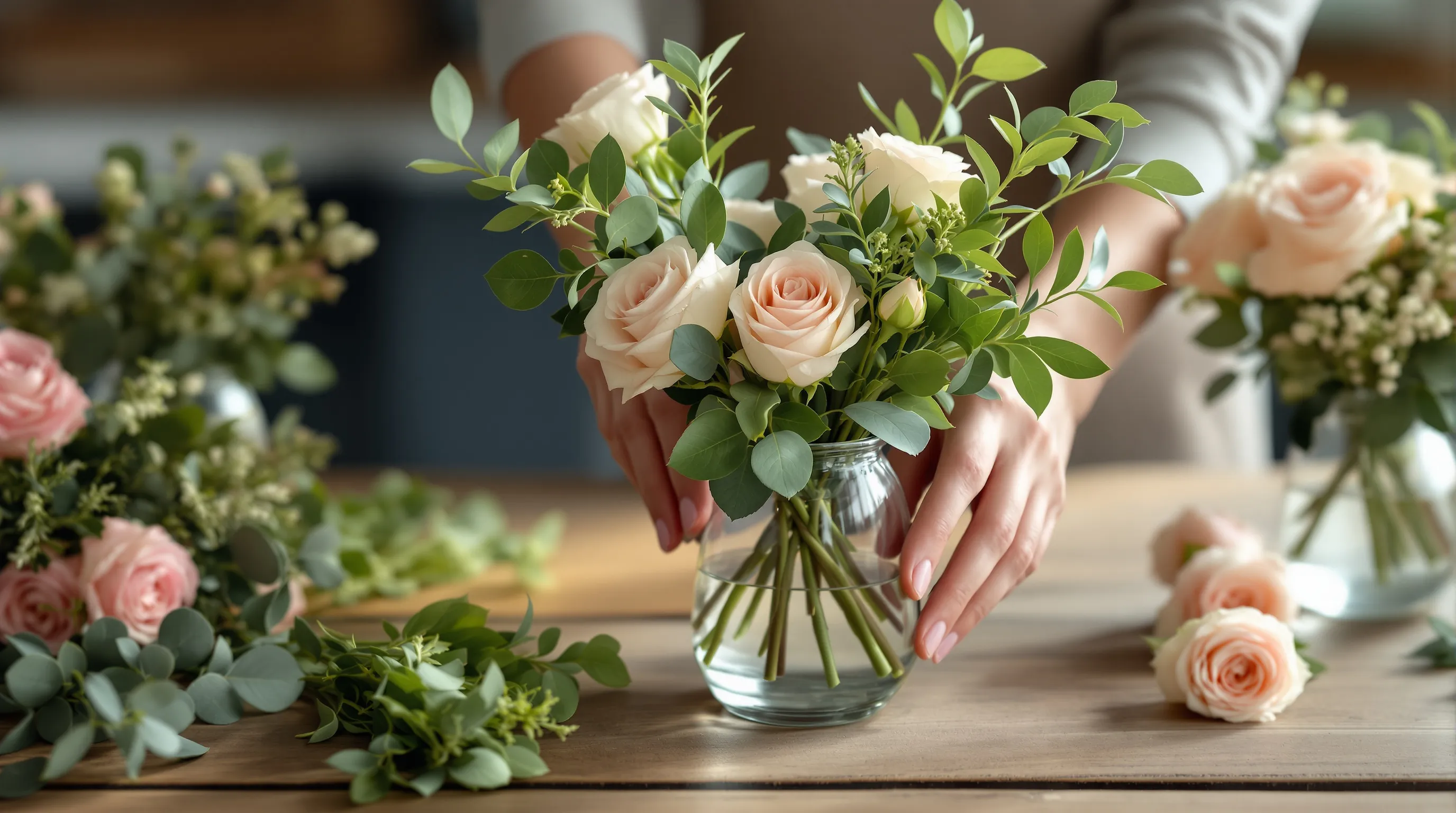
How do you calculate your total stem count in three steps?
We call this the Three-Layer Method, or the TLC method for short. It is the same math our team walks DIY brides through every week, and it works at any guest count.
The Three-Layer Method is the framework Blooms By The Box uses when helping customers plan their wholesale flower orders. It breaks the total stem count into three distinct layers, each calculated separately, then added together. This approach is the result of reviewing thousands of orders over nearly two decades and identifying where buyers consistently order short.
Layer 1: Centerpieces. Use the table above to find your style. Multiply stems per table by your table count. Example for 150 guests with bud vase clusters: 18 tables at 28 to 32 stems each = 504 to 576 centerpiece stems.
Layer 2: Personal flowers. This is the most commonly under-counted layer. Add up:
- Bridal bouquet: 40 to 60 stems (medium cascade or round style)
- Bridesmaid bouquets: 15 to 25 stems each (6 bridesmaids = 90 to 150 stems)
- Boutonnieres: 2 to 3 stems each (groomsmen, fathers, ring bearer)
- Corsages: 3 to 5 stems each (mothers, grandmothers)
- Flower girl basket: 20 to 40 stems total
A typical wedding party of 6 bridesmaids, 6 groomsmen, and 4 corsages adds 160 to 260 stems to your total from Layer 2 alone.
Layer 3: Ceremony decor. Ceremony flowers are often the largest single variable in the order:
- Full floral arch: 150 to 250 stems
- Half-floral arch: 80 to 120 stems
- Aisle markers (pew cones or chair ties): 5 to 8 stems each, typically 10 to 20 markers = 50 to 160 stems
- Altar arrangement: 30 to 60 stems
Add all three layers together, then add a 10% buffer for stems that open early, arrive damaged, or don't match your vision on the day of. Round up to full bunches - roses come 25 per bunch at Blooms By The Box; spray roses come 10 per bunch; carnations come 25 per bunch. The Three-Layer Method total before rounding is your working number. After rounding up to full bunches and adding the buffer, that is your order.
Here is what the complete Three-Layer Method looks like for a 150-guest bud vase wedding with 6 bridesmaids and a half-floral arch: 540 (centerpieces) + 220 (personal flowers) + 100 (ceremony) = 860 stems, plus a 10% buffer = 946 stems, rounded to the next full bunch count.
What does the stem count process look like when someone actually works through it?
Seeing the math in action is the fastest way to make it click. This tutorial walks through a real-world DIY flower order, tracking stem counts arrangement by arrangement from bud vases to bouquets.
The tutorial is useful because it tracks the cumulative stem count in real time, showing exactly how 50 bud vases add up to 378 stems before a single bouquet or boutonniere is counted. That running total is what makes the three-layer approach feel concrete rather than abstract. I find that first-time buyers who watch something like this before ordering are far less likely to undercount their personal flowers.
How does your flower variety affect your total stem count?
The flower you pick changes how many stems you need in every arrangement. Denser blooms fill a vase faster; single-headed flowers need more stems to get the same look.
This is one of the factors that most wedding planning guides skip over, and it is the reason two weddings with identical guest counts and identical table layouts can end up with stem totals 200 stems apart. Flower variety is not a decoration detail. It is a math variable.
According to the Wedding Arrangements and Bouquets Checklist from Brides, the most common wedding flowers cluster into two categories by density. Large focal blooms, such as peonies, dahlias, and garden roses, fill space quickly. One to three of these per vase is often enough. Filler stems and accent blooms, including spray roses, lisianthus, and alstroemeria, require more stems per arrangement to build volume.
In practice, this means a bud vase filled with spray roses may need 8 to 10 stems to look full. The same vase with a single peony and two eucalyptus sprigs uses 3. The visual result can look similar. The stem count is more than three times higher for one option versus the other.
The takeaway: decide your focal flower first. Then calculate stems per arrangement based on that variety, not on a generic per-vase estimate.
A Practical Wedding’s published fall bouquet recipe shows the same logic in action: one focal rose, three fillers, and foliage, coming in at under $50 in flowers for the bouquet. Swap the focal from a rose to a dahlia and the stem counts shift, but the recipe structure holds.
From what I have seen working with customers across a wide range of wedding sizes, the other number most people forget to think through is budget per stem. Professional florist quotes often include markup, labor, and overhead. According to conversations in the professional florist community, the frustration for many working florists is that clients do not realize what a stem actually costs wholesale versus what it costs fully arranged. Buying wholesale directly removes that markup entirely.
At Blooms By The Box, our wholesale selection includes both focal and filler flower types across a wide range of varieties. Whether your design is rose-forward or built around spray flowers and greenery, the stem-per-arrangement math works the same way: know your variety, look up typical stems-per-arrangement for that type, and multiply across your table count and personal flowers layer. We include variety-specific guidance in our product pages to make that step easier.
The good news is you only have to do this math once. Once you have your stem count per variety, you can build the order list in minutes.
Quick-Reference: Three-Layer Stem Count for 100, 150, and 200 Guests
Use this calculation pattern to build your own order list. Adjust stems per arrangement based on your chosen style and flower variety.
| Layer | 100 Guests (12 tables) | 150 Guests (17 tables) | 200 Guests (22 tables) |
|---|---|---|---|
| Centerpieces (bud vase style, 30 stems/table) | 360 stems | 510 stems | 660 stems |
| Personal flowers (bouquet, party, boutonnieres, corsages) | 220 stems | 260 stems | 300 stems |
| Ceremony decor (aisle, altar, arch) | 100 stems | 125 stems | 150 stems |
| Subtotal | 680 stems | 895 stems | 1,110 stems |
| Add 10% buffer (round up to full bunches) | 748 stems | 985 stems | 1,221 stems |
Stems per table vary by style. Low centerpieces use 15 to 20 stems; tall arrangements use 25 to 35. Take delivery about 2 days early to allow blooms to open. Fresh wholesale stems ship in bunches of 10 (most varieties) or 25 (roses, carnations).
How do you turn your stem total into a product order?
Your stem count will almost never divide cleanly into bunches of 10 or 25. That is why you round up and add a buffer before you touch the cart.
Aisle petals deserve the same rounding respect. In one filmed test, covering a single square yard in a rich petal carpet took 50 stems of red roses, while about 20 of the larger-headed yellow Brighton roses did the same job. Petal coverage eats stems faster than any centerpiece, so give it its own line in your order.
This is where the math shifts from a planning exercise into a purchasing decision, and that shift introduces friction most stem-count guides do not address. You have a number: say, 580 stems for a 100-guest wedding. Now you have to translate that number into actual products in actual bunch sizes. The rounding almost always adds 5 to 15 percent to your working total.
According to a floral DIY tutorial that tracks stem counts in real time, 50 bud vases filled with a typical mixed arrangement uses 378 stems. That breaks into 38 bunches of 10, rounded up to 40 for the buffer. The difference between 378 and 400 is your insurance for stems that arrive tight, damaged, or that open before you are ready to arrange. Skipping the buffer is the fastest way to run short the day before the wedding.
The product selection step adds a second layer of friction. As of September 2026, Blooms By The Box carries 1,470 products. That breadth is useful when you know what you want, and it can feel overwhelming when you are starting from a stem count alone. In my experience, the easiest way to navigate a wide catalog is to decide on two or three focal flowers and one greenery variety before you start browsing. Everything else is filler, and filler is more flexible.
According to real wedding cost breakdowns, full-service floral budgets for 100 to 200 guests typically run between $3,000 and $5,000 once labor, rentals, and markup are included. Wholesale DIY orders for the same guest counts tend to land in the $400 to $900 range for stems only, not including vessels or supplies. That gap is real. It is also the entire reason wholesale purchasing exists for people willing to do the arranging.
What this means in practice: once you have your three-layer stem total, divide each variety by its bunch size, round up, add 10 percent, and check that each quantity falls above the minimum order for that product. Those four checks convert a calculation into an order that will actually arrive ready to use.
You've got this. The math is mechanical after the first pass, and we have done it enough times to know where the friction points are.
What changes when you calculate stems layer by layer instead of guessing?
A rough estimate usually misses the personal flower and ceremony layers entirely. The three-layer method gets you within 5 to 10 percent of your real total before you add the buffer.
Before: A 100-guest couple estimates "about 500 stems" based on a 5-per-guest rule of thumb. They order 50 bunches of 10 and run short. The ceremony arch is bare, and two bridesmaid bouquets are half-sized. The leftover table flowers never get used.
After: The same couple runs the three-layer calculation: 360 centerpiece stems, 220 personal flowers, 100 ceremony decor, plus a 10 percent buffer. They order 75 bunches total. Everything is covered. Nothing is wasted. They place the order three weeks out and take delivery two days before, so stems arrive open and ready to arrange.
The difference is not a bigger order. It is a more accurate one built from how the flowers are actually used.
How do you choose the right wholesale supplier for your order?
Choose the supplier that can fill your whole variety list in one order, in the stem counts you actually need. Blooms By The Box ships directly to individuals and event planners in bunches as small as 10 stems, so a three-layer count does not have to be split across several sources.
This is a question that comes up constantly in wedding planning communities, and the answer surprises a lot of first-time buyers. The assumption is that wholesale means pallet quantities and a reseller license. For most online suppliers, that is simply not true. You shop, you order, the flowers arrive at your door ready to condition and arrange.
The question worth asking is not whether you can buy wholesale, but which supplier is the right fit for your order size and variety needs. Sourcing choices at this stage have a larger effect on your final result than most people expect.
Fresh versus artificial is the other decision that comes up here. Fresh flowers have a natural warmth and texture that artificial options have not been able to fully replicate, especially in photography. According to discussions in the DIY wedding community, the consensus is that fresh flowers remain the preferred choice for personal flowers and centerpieces at weddings where photography is a priority. The scent, the weight, and the way petals catch light all contribute to the final look in ways that matter.
According to sourcing discussions among budget-conscious buyers, warehouse clubs do sell pre-bunched flowers, but they offer limited variety, no custom sizing, and no ability to mix stems across an order. That works for a simple grocery-store look. It does not work when you have a specific palette or a variety list built from your three-layer calculation.
In my experience working with customers who come to Blooms By The Box after trying retail alternatives, the biggest frustration is discovering that the retail option did not carry the exact varieties they needed. Ordering from a dedicated wholesale supplier lets you specify exact stems, exact quantities, and exact delivery windows aligned with your conditioning timeline.
The takeaway: once you have your stem count and your variety list, look for a supplier who carries all of it in one order. Splitting across multiple sources multiplies your conditioning logistics and your shipping risk. A single well-planned order is easier to manage than three smaller ones.
| Arrangement Style | Stems per Table | 100 Guests (12 tables) | 150 Guests (17 tables) | 200 Guests (22 tables) |
|---|---|---|---|---|
| Bud vase cluster (4 vases, 7-8 stems each) | 28-32 | 336-384 | 476-544 | 616-704 |
| Low bowl / garden-style centerpiece | 15-20 | 180-240 | 255-340 | 330-440 |
| Tall glass vase arrangement | 25-35 | 300-420 | 425-595 | 550-770 |
| Personal flowers (bridal bouquet + 4 bridesmaids + 6 boutonnieres + 2 corsages) | N/A | ~220 | ~260 | ~300 |
| Ceremony decor (arch, aisle, altar) | N/A | 80-150 | 100-175 | 125-200 |
What will matter most when planning bulk flower orders over the next year or two?
The biggest shift is toward recipe-based stem math. Buyers who plan by arrangement style and three-layer totals before ordering get consistently closer to their real stem count than those working from rough per-guest rules.
| Trend | Weak Signal Now | Why It Matters |
|---|---|---|
| Bucket and recipe math replaces per-guest rules | According to sourcing guides and DIY planning communities, buyers already convert table counts into exact bucket totals (50-75 stems per bucket) and per-arrangement stem recipes rather than relying on 5-to-7-per-guest shortcuts. | Buyers who plan by recipe avoid both over-ordering and the short-order panic that comes from ignoring personal flowers and ceremony decor. |
| Demand for guest-count-scaled wholesale sourcing guidance keeps growing | Unanswered buyer questions about sourcing bulk stems by budget and guest count, and about alternatives to big-box retailers, recur consistently across planning forums and community threads. | Buyers currently piece together stem totals from scattered tutorials. Suppliers who offer clear guest-count-based guidance earn the order before the customer wanders elsewhere. |
What most buyers miss is that both shifts point the same way. It means the planning math at 200 guests looks genuinely different from the math at 100, and that difference is worth building into your order before you hit checkout.
12-24 months Forecast, In Order
Where Bulk Wedding Flower Buying Heads Next
Two evidence-based forecasts for how couples and planners will source and size flower orders for 100 to 200 guest weddings.
Forecasts For Guest-Count Flower Ordering
Use these forecasts to gauge how bulk flower buying patterns may shift as you plan quantities for your guest count.
Buyer questions about sourcing bulk wholesale flowers by budget and guest count, and about alternatives to warehouse clubs and other online bulk suppliers, will keep recurring over the next 12-24 months, pushing suppliers toward clearer guest-count-to-stem-count and guest-count-to-price guidance and bundled packs.
Couples and DIY planners sizing orders for 100-200 guests will rely more on standardized bucket counts (50-75 stems per 2.5-gallon bucket) and per-arrangement recipes, converting table and bouquet counts directly into stem totals.
Faint signals worth tracking: Community sourcing already treats buckets as the standard bulk unit (50-75 stems per bucket) and translates table counts into exact stem totals, such as 378 stems for 50 bud vases. Multiple unanswered buyer questions about bulk wholesale sourcing, budget-based ordering, and alternatives to established bulk suppliers recur across platforms.
Supporting and contrary evidence
Each forecast lists the real-world sources behind it.
- Frustrated by how much flowers are. points the same way. [Community / Forum]OP (irun2eatwaffles) was quoted $175 for a bridal bouquet. “we work best with couples whose minimum budget for wedding celebrations is 20,000 dollars”
- The case rests on How did DIYing your wedding flowers go? [Community / Forum]Original poster budget: £15,000 total for 80-100 guests, wedding planned for spring in Brighton, East Sussex. “It was absolutely worth it, the flowers cost £300 from the market and were stunning.”
- DIY florals: How many flowers? points the same way. [Community / Forum]A florist source (referenced by commenter nugepham) states a bucket of flowers is about 2.5 gallons and equates to 50-75 stems, "depending on the size of the flower/greenery.". “a bucket is about 2.5 gallons which equates to 50-75 stems, depending on the size of the flower/greenery" - nugepham, relaying guidance from a flower farm”
- The case rests on Flowers! How did you decide how many you'll need? [Community / Forum]Original poster (u/danceswithtreez) is planning a wedding with 5 bridesmaids and approximately 80 guests. “Usually it is 'by the bucket' and a bucket will generally have 50-75 stems depending on the type of flower and the farmers preference.”
- DIY Flower Arrangement Calculations is the strongest public backing for this call. [Video]Flowers should be delivered three days before the event (e.g., Wednesday delivery for a Saturday event). “I suggest having a minimum of five flowers within your recipe”
What could change these forecasts
These scenarios describe the market shifts that would push flower buying trends in a different direction.
What Could Undercut This
Recurring buyer demand for guest-count guidance is the best-supported call here, and bucket-and-recipe math the least settled of the two. Weigh both before treating either as fixed.
- Suppliers publish clear guest-count-to-stem-count guidance of their own, the recurring buyer questions stop recurring, and the first forecast loses its footing.
- Bunch sizes and bucket counts stop being standard across growers, and per-arrangement recipes become the only reliable unit.
Frequently Asked Questions About Wedding Flower Quantities
How many stems do I need per table?
It depends on your style. Bud vase clusters, the most popular DIY format, use 4 vases per table at 7 to 8 stems each: roughly 28 to 32 stems per table. Low bowl centerpieces run 15 to 20 stems. Tall glass vase arrangements use 25 to 35 stems per table.
What flowers come in bunches of 25?
Roses and carnations typically ship in bunches of 25. Most other varieties, including spray flowers, lisianthus, and greenery, ship in bunches of 10. This matters when you divide your total stem count into order quantities.
How far in advance should I order bulk wedding flowers?
Place your order 2 to 3 weeks before your delivery date, and have the flowers delivered about 2 days before the event, so there is time to condition them. Conditioning means cutting the stems, placing them in water, and letting them fully hydrate and open. Same-day delivery leaves no time to replace stems that arrive damaged or still closed.
Is it cheaper to buy wholesale flowers than hire a florist?
Usually yes. Wholesale pricing removes the florist's labor and markup costs. The savings are significant for anyone willing to do the arranging themselves.
Key Takeaways
Key Takeaways: The Three-Layer Method
- Calculate all three layers before you order. Centerpieces are only Layer 1 of The Three-Layer Method from Blooms By The Box. Personal flowers and ceremony decor together add 200 to 400 stems to a typical 100-guest order. At Blooms By The Box, we've found that buyers who calculate all three layers before ordering land within 5 to 10 percent of their actual needs; buyers who calculate only centerpieces typically run 20 to 35 percent short.
- Style drives your stem count more than guest count does. A bud-vase 100-guest wedding and a tall-centerpiece 100-guest wedding differ by more than 400 stems. Decide your arrangement style before you build your count, and use the table in this guide to look up the stems-per-table range for your chosen format.
- Add a 10 percent buffer before placing your order. Fresh wholesale stems arrive in bud form and may include occasional transit damage. A 10 percent buffer covers the most common losses. For delicate focal blooms like ranunculus or garden roses that come in small bunches of 10, we recommend a 15 percent buffer.
- Order 2 to 3 weeks ahead, for delivery about 2 days before your event. Blooms By The Box ships nationwide with same-day processing. Ordering that far ahead is what the site advises for weddings and large events, and taking delivery a couple of days early gives you time to condition, hydrate, and open flowers at the right stage. A Practical Wedding and WeddingWire both document this 2-to-3-day conditioning window as the standard for DIY floral success.
- The Three-Layer Method works at any guest count. 100 guests, 150 guests, 200 guests: Layer 1 (centerpieces) plus Layer 2 (personal flowers) plus Layer 3 (ceremony decor) equals your complete stem count before rounding and buffer. Our research across thousands of Blooms By The Box orders since 2007 confirms this three-layer framework as the most reliable approach for first-time DIY buyers.
The gap between a short order and a complete one almost always comes down to the same thing: a buyer who planned for the tables but forgot to count the personal flowers and ceremony decor. Calculate all three layers before you order anything.
Fresh wholesale flowers deliver a warmth and texture that holds up through a full wedding day and photographs in a way that artificial options still cannot consistently match. For most weddings, the case for ordering fresh is not about preference. It is about result.
Your next step is straightforward: take your guest count, divide by 8 or 10 to find your table number, pick your style, and run through the three-layer total. Order 2 to 3 weeks ahead. Build in the buffer. That sequence works whether you are doing bud vases for 100 guests or statement arrangements for 200.
Sources & Further Reading
Where can you learn more about DIY wedding flower planning?
I find the most useful resources are the ones that walk you through a real example, not just a formula. Here are the ones I return to most often.
- A Practical Wedding's DIY Bouquet Guide: Covers specific bouquet recipes with exact stem counts, including Ivory Vendela Rose (3 stems), White Wax Flower (5-6 stems), Tree Fern (7-10 stems), and Alstroemeria (3 stems). This is one of the most-cited first-hand DIY floral resources available online for non-professional designers.
- Brides.com Wedding Flowers Checklist: Includes the 10 to 15 percent budget benchmark and a full list of every floral piece a wedding may need, from boutonnières to ceremony arch flowers. Shannon Morrow of Arvo Floral Studio and Alexis D. Greene, a New York City floral designer, both contribute expert guidance in this guide.
- Society of American Florists (SAF): The primary U.S. trade organization for floral professionals. SAF's Floriology Institute publishes seasonal variety guides and availability data useful for choosing varieties that will actually be in stock on your event date.
- Blooms By The Box Flower Care Library: Step-by-step conditioning guides for every variety we carry, included free with every order. Covers hydration schedules, water temperature, and variety-specific handling for roses, ranunculus, hydrangeas, alstroemeria, and specialty blooms. Published September 2026.
- WeddingWire and The Knot Budget Tools: Useful for benchmarking the 10 to 15 percent floral budget guideline against your total wedding spend, then cross-referencing with wholesale per-stem pricing from Blooms By The Box to see how far that budget stretches when buying direct.
Related Articles
Written by
Joan
Owner, Blooms By The Box
Joan Wyndrum is a co-founder of Blooms By The Box, an online destination for fresh wholesale flowers and floral supplies.
Connect on LinkedInSummarize This Article With AI
Open this article in your preferred AI engine for an instant summary.