Quick Answer
For bulk buyers, 3-5-8 is a stem recipe: 3 focal, 5 secondary and 8 filler stems per arrangement. Multiply each line by your arrangement count, add spares, and order.
The other reading, about height and proportion, helps you cut stems to fit a vase. It can't tell you what to buy. The recipe works the same way for 15 tables or a 120-guest list; only the multiplier changes.
Key Points
- For bulk buyers, 3-5-8 means 3 focal, 5 secondary and 8 filler stems per arrangement, and Blooms By The Box's average is $3 to $4 per stem for bulk wedding varieties.
- Florists' Review, reporting The Knot's Real Weddings Study, found couples spent an average of $2,800 on wedding flowers in 2025, and $3,300 for weddings with 101 or more guests.
- Blooms By The Box advises ordering 2 to 3 weeks before your delivery date, or up to 120 days ahead, with delivery about 2 days before the event.
Most couples who land on the 3-5-8 rule are really asking something more practical. How do I make DIY wedding centerpieces for 15 tables with bulk flowers on a budget? How many stems do I need for a wedding with 120 guests? And how do I actually order them?
Those are buying questions. A design rule only earns its place if it answers them.
The people asking aren't all the same buyer, either. In 2021, a Canadian wedding florist told the Girl Flower Podcast that over the previous five years, wedding clients had split into two groups: couples for whom flowers matter most, and couples who want some flowers without making them the top priority. If you're building your own arrangements on a set budget, you need something firmer than taste. You need a count.
That's where I part ways with the usual explanations. I'd rather hand you a number you can type into a cart than another debate about what the rule means. So start with one simple question for yourself: which three flowers will fill your focal, secondary and filler tiers?
Here's what the rest of this guide walks you through:
- Stem recipe: how 3 focal, 5 secondary and 8 filler stems become a per-table count you can multiply.
- Guest count: how that count grows when your list reaches 120.
- Budget and timing: where the money goes once the count is fixed, what the evidence can't tell you yet, and when to order.
The 15-table question comes first. It's the one most people get stuck on.
You've probably seen 3-5-8 pinned to a mood board or tossed into a forum thread, usually with a confident nod and no math attached. Here's the direct answer: for a bulk order, 3-5-8 means 3 focal stems, 5 secondary stems and 8 filler stems in every arrangement. With our extensive selection of bulk flowers and greenery, finding stems is rarely the hard part; knowing how many is.
Why does that matter so much? The other reading treats 3-5-8 as a sense of proportion and height. A sense can guide your hands at the table. It can't fill a cart.
"How many flowers do I need for my arrangement?" is the most common question we hear from our customers. I wrote that line in my 2023 guide, How Many Flowers Do I Need?. A design rule that can't answer it leaves a first-time DIY bride guessing at a bulk order for a whole reception. She deserves a clearer path.
Price is the second trap. In 2026, a wedding florist told a cut flower grower podcast that one of the most expensive flowers on the market, lily of the valley, is also the shortest. Height alone can't tell you what an order will cost. Stem counts can. Your first step is to list every piece you need, from centerpieces to the bridal bouquet, before you choose a single bloom.
So let's start where most planners do, with a real number of tables.
Questions this article answers
How can you make DIY centerpieces for 15 tables with the 3-5-8 rule?
Read 3-5-8 as a stem recipe for each arrangement: 3 focal, 5 secondary and 8 filler stems, then repeat that recipe once for every table you plan to fill.
Here's how to start before you open a single product page:
- Count your arrangements first. Fifteen guest tables means at least 15 centerpieces, and our table-plus-five rule adds five accent pieces for the spots where guests gather.
- Pick one flower for each tier: a focal bloom, a secondary bloom and a filler.
- Order each tier as its own line, so the 3, the 5 and the 8 each repeat once for every piece.
Guides quote the rule in more than one way, and two readings cause most of the confusion.
Reading one: a rule of composition
The first reading uses the numbers for shape, not stems. A common design guideline in this camp says the flowers should stand about 1 1/2 times the height of the vase. Read this way, 3-5-8 describes how an arrangement should look: its balance, its layers, its height against the vessel.
That's useful design advice. Before you count, ask yourself one question: will all 15 tables get the same vase, or will a head table need a taller piece?
Reading two: a tiered stem recipe
The second reading turns each number into a count. Here's what each tier means in plain words:
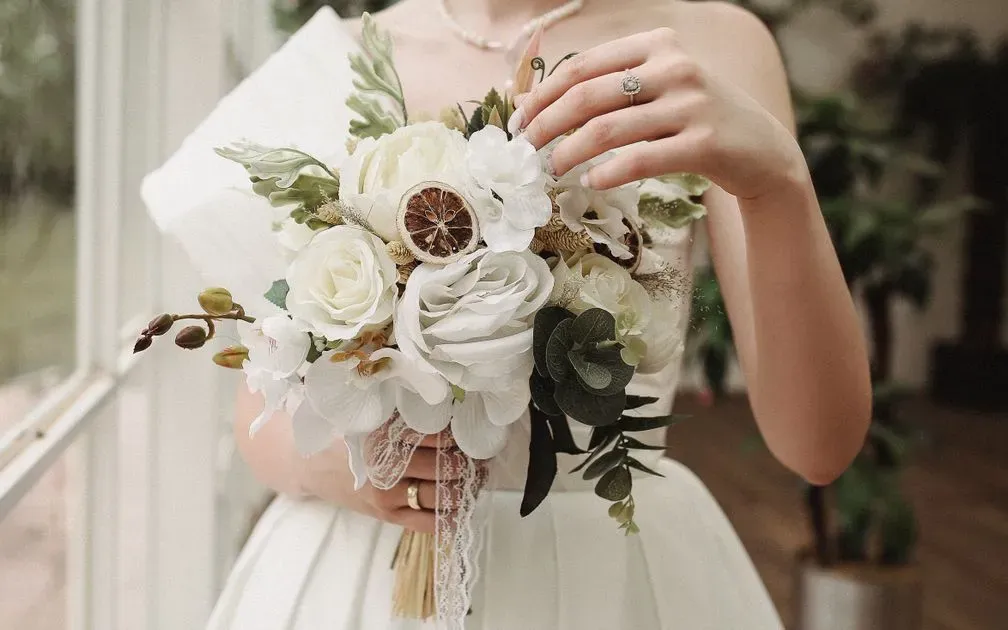
- Focal flower: the big bloom your eye lands on first. For example, a classic rose.
- Secondary flower: a mid-size bloom that supports the focal. For example, spray roses or lisianthus.
- Filler flower: small, airy stems that add volume and soften gaps. For example, baby's breath or waxflower.
Each reading answers a different question at the table. For a sense of scale, our stem count guide fills a pint mason jar with two greenery stems and eight focal and filler flowers, and a quart jar with four or five greens and 12 to 15 flowers. A 3-5-8 recipe, at 16 flowers, runs just past that quart jar.
Whichever version you start from, guessing your stem count is a risk you don't need to take. Our guide notes that every count can bend with your preferences, flower type and arrangement style, so treat 3, 5 and 8 as a starting line you can adjust.
Here's the number to hold beside each tier. At Blooms By The Box, our average wholesale price is $3 to $4 per stem for bulk wedding varieties, so every line on your recipe maps to a real number. If you're still choosing which blooms to slot into each tier, our page of popular wedding flowers for DIY designs is a friendly place to browse.
So which reading wins? Build one sample centerpiece, keep the version your helpers can repeat at all 15 tables, and you'll see exactly where florists and DIY brides start to part ways.
Why do florists and DIY brides disagree about the 3-5-8 rule?
Florists use 3-5-8 as a design habit shaped by season, stem length and pricing, while DIY buyers need a fixed count they can order, pay for and unpack.
You already know a florist and a first-time DIYer look at the same bouquet differently. The gap is wider than taste, though. It comes down to three things a working designer juggles that a recipe card never mentions.
Season changes the palette
One wedding and event florist, speaking on a cut flower grower podcast in 2026, put it simply: "no two weddings are ever the same, no two brides are ever the same in terms of what they want." She described a color calendar in which blue and purple weddings are "definitely kind of July, August, September," while hot colors tend to arrive in late summer alongside dahlias. A pro builds around that rhythm first and counts later.
Stem length changes the count
That same florist said she might need stems "everything from 30 to 100 centimetres." Her most popular wholesale length is 60 cm, yet 60 cm is too long for bridal posies and bridesmaids' bouquets, and 30 cm is a good size for a bud vase. Think of it this way:
- Before: "I need 3 focal stems." Which length? For which vessel?
- After: "I need 3 focal stems per bouquet, cut down for a hand-tied posy." Now the count means something.
Our own stem count guide puts numbers on it for mason jars: cut stems to 10 to 12 inches for a pint jar and 16 to 18 inches for a taller quart jar.
Pricing hides the count
A Society of American Florists pricing framework, which dates from around 2015, marks flowers and foliage up 3.5 times and sets labor for a handheld bouquet at 35 percent of the retail price. A quote built that way bundles stems, labor and markup into one figure. You never see the recipe underneath.
That's the heart of the disagreement. Florists don't need a shopping list, because the list lives inside their studio.
You do. If friends are helping you build centerpieces the week of the wedding, they can't work from "make it balanced." They can work from 3, 5 and 8.
My advice? Keep the florist's wisdom about season and length, and layer the count on top. If your date falls in the warm months, browsing summer bulk flowers for DIY weddings helps you match each tier to what's fresh, and from there the only question left is how many stems a real guest list adds up to.
What happens when you put real numbers into the 3-5-8 rule?
The 3-5-8 rule is easy to quote and harder to shop from. We took the one reading that becomes an order, set it beside our own stem counts, priced it, and found two catches that show up after checkout.
We started with our own numbers. Our stem count guide builds a medium centerpiece, in a vase with a 5 to 6 inch opening, from about 20 stems including greenery. My 2023 stem chart puts a medium mixed bouquet of focal, secondary and filler flowers plus greens at 18 to 20 stems, and a large one at 25 to 30.
A 3-5-8 recipe is 16 flowers with no greenery line at all. Add a few greens and it lands on our medium size; a large piece needs more than one recipe's worth. The proportion reading, usually given as flowers about 1 1/2 times the height of the vase, helps a designer judge a finished piece, but it names no stems.
| Reading of the rule | What it gives you | A stem count to order? | A cost you can check? |
|---|---|---|---|
| Stem recipe: 3 focal, 5 secondary, 8 filler | 16 stems per arrangement | Yes | Yes, at our average |
| Proportion: flowers 1.5 times the vase height | Where to cut each stem | No | No |
Once you read the rule as a recipe, the math is short. At our average of $3 to $4 per stem for bulk wedding varieties, 16 stems come to roughly $48 to $64 of flowers per arrangement, before spares. Your own mix of varieties sets the real figure.
A checkable number means more beside real spending. Earlier this month, the trade magazine Florists' Review reported figures from The Knot's Real Weddings Study of 10,474 U.S. couples. Their average flower spend in 2025 was $2,800, with a median of $1,900. Those figures cover bouquets, boutonnieres, wedding party flowers and centerpieces together, and they rise with the guest count.
The same article sets out the pricing framework the Society of American Florists published, written by CPA Paul Goodman. For centerpieces, flowers and foliage are marked up 3.5 times, and labor is set at 20% of the retail price. Florists' Review says the framework appears to date from around 2015 and advises florists to test it against today's costs. In a florist's quote, the stem cost is folded into a marked-up total. In a counted order, you see it line by line and supply the labor yourself.
The proportion rule returns at the worktable. Jo, a florist who does weddings and events, told the Becoming A Cut Flower Grower podcast in May 2026 that her designs need stems from "everything from 30 to 100 centimetres and anywhere in between." A 60 cm stem gives "a decent sized flower head," she said, yet for bridal posies and bridesmaids' bouquets "60 is too long," while 30 cm is "a good size for a bud vase." The host, a first-time grower, said most stems on wholesale websites are listed at 60 or 70 cm. So the 1.5 times guideline has a job after all: measure the vase, then cut. The count decides what you buy. The proportion decides how much of each stem stays on the table.
One more cost never shows up on an invoice: prep time. Our FAQ advises having flowers delivered 2 days before your event so everything has time to rehydrate and bloom. Our unpacking guide asks for at least 3 to 5 hours of drinking time after you recut the stems, ideally overnight, and at least 12 hours for roses. Those hours come before anyone builds a single centerpiece. We sell wedding flower packs and curated collections as well as loose stems, so you can pick loose stems for full control or a pack that takes the guesswork out of how many bunches you need.
Laid side by side, the findings split the rule into three jobs. The count tells you what to buy and lets you check the price. Proportion tells you where to cut. Time decides whether 16 stems become a centerpiece before the guests arrive. Only the first job happens before checkout, which is why the count is the version to order from.
Before you place the order
- When a guide mentions 3-5-8 without numbers, treat it as a design note and find the counts before you shop.
- Write each arrangement as 16 stems in three tiers, multiply by the $3 to $4 average, and set the total beside The Knot figure for your guest count.
- Compare your total with a florist quote knowing that the quote multiplies flower cost and adds labor, while your order leaves the labor to you.
- Measure every vase and bouquet before the flowers arrive, use the 1.5 times guideline to set cutting lengths, and expect to cut long stems down for bud vases and handheld bouquets.
- Estimate your arranging hours as carefully as your stem count, then decide whether loose stems or a wedding flower pack fits the time you have.
How we checked this
We set the recipe beside our own stem count guide, my 2023 stem chart, our FAQ and our unpacking guide, then read a trade magazine article that reports The Knot's 2025 spending survey and the Society of American Florists pricing framework, and a May 2026 podcast conversation between a first-time grower and a UK wedding florist. The $3 to $4 average stem price is ours and covers bulk wedding varieties as a group. It does not give the price of any single flower. The Knot figures cover all wedding flowers, so they do not show what couples spend on centerpieces alone. The pricing framework appears to date from around 2015. Our guide's counts are starting points that change with flower type and style, and the florist's stem lengths come from her own UK practice. We sell flowers by the stem and in packs, so we have a stake in how you read this rule. Still unknown: how long a 16-stem arrangement takes a first-time arranger. None of our sources measured that.
- Blooms By The Box, DIY floral design stem count guide, July 2024.
- Florists' Review, wedding flower pricing formula article, citing The Knot's Real Weddings Study and the Society of American Florists, November 2026.
- Becoming A Cut Flower Grower podcast, episode transcript with a wedding florist, May 2026.
- Blooms By The Box, How Many Flowers Do I Need?, May 2023, and our wholesale flowers FAQ.
- Blooms By The Box, average wholesale stem price for bulk wedding varieties, as of November 23, 2026.
How many bulk stems do you need for a 120-guest wedding using 3-5-8?
Apply 3, 5 and 8 stems to each arrangement, multiply by how many arrangements you need, add spares, then fill each tier with bulk stems or wedding flower packs.
Before you total anything, check whether the sweetheart table and the cake table each get an arrangement too. Here's the order of operations:
- List every arrangement you plan to make: centerpieces, bridal bouquet, bridesmaid bouquets.
- Write the recipe beside each one: 3 focal, 5 secondary, 8 filler.
- Multiply each tier by how many of that arrangement you need.
- Add a few spare stems per tier, and put greenery on its own separate line.
A worked example for 120 guests
Your seating chart sets the table count, not the guest count. For this example, say your 120 guests sit at 15 tables, each with one centerpiece built on the recipe.
| Tier | Stems per centerpiece | Centerpieces | Stems to order |
|---|---|---|---|
| Focal | 3 | 15 | 45 |
| Secondary | 5 | 15 | 75 |
| Filler | 8 | 15 | 120 |
| Total before spares and greenery | 16 | 15 | 240 |
Now add rows for your personal flowers, sized from our stem count guide rather than one recipe each. A bridal bouquet typically takes 30 to 35 stems, 12 of them greenery. A bridesmaid bouquet takes about 15 stems, five of them greenery, and a boutonniere three or four. Add those rows under the centerpieces and you have a full stem list.
The bridal bouquet carries more stems than any centerpiece, so I'd write that row first. One budget tip from my 2023 guide: save the larger 60 cm roses for the bridal bouquet and use the less expensive 40 cm roses elsewhere.
Where does the budget land?
For context, The Knot's 2025 figures, as reported by Florists' Review, put average flower spend at $3,300 for weddings with 101 or more guests. That number includes bouquets, boutonnieres, wedding party flowers and centerpieces, so it's a sanity check, not a target.
I'd price the focal line first. Those stems usually set the tone of the whole order.
Bulk stems or packs?
You don't have to build every tier from loose stems. Our wedding flower packs and curated collections group varieties that already work together, which can cover a tier in one click. Loose bulk stems give you tighter control over each count. Many couples mix the two.
Prices and availability shift through the year, and the examples here reflect our store catalog as of November 23, 2026. If you're picking focal blooms with a softer, lush look, our wholesale garden wedding flowers are a natural place to fill the 3.
Counts like these hold steady when prices move, and that's the next question worth a straight answer.
Will the 3-5-8 rule still work for bulk buyers as flower prices change?
Yes, as long as you treat it as a stem recipe per arrangement. Counts survive price swings, season changes and vase choices, while a loose proportion rule leaves you guessing at checkout.
Prices don't sit still. In 2021, a Canadian wedding florist told the Girl Flower Podcast that wholesale flower prices had risen about 30% on average, and that the studio raised its wedding booking minimum every year to keep pace.
That's why I keep coming back to counts. When costs climb, a proportion gives you nothing to trim. A recipe does. You can swap a focal variety, shift your secondary line to something in season or hold the filler steady, and you still know exactly how many stems will land on your doorstep.
Our own budget advice works the same way. When a bloom runs over budget, substitute a less expensive one with a similar color, texture and size: groupings of carnations instead of peonies, football mums for garden roses, or tulips for ranunculus. The slot stays the same; only the variety changes.
So grab one vase, set it on one table and write down three numbers. The cart comes after that.
Summarize This Article With AI
Open this article in your preferred AI engine for an instant summary.
Frequently Asked Questions
What else do people ask about the 3-5-8 flower rule?
Most questions come back to one thing: how a design rule turns into a stem order. Here are the ones I hear most, answered plainly.
What is the 3:5:8 rule for flowers?
The 3:5:8 rule is a stem recipe for one arrangement: 3 focal stems, 5 secondary stems and 8 filler stems. Other guides use the same numbers for shape, as a feel for how tall the flowers stand against the vase. For buying, the stem reading is the useful one.
What is the 3:5:8 rule for weddings?
It's the same recipe, repeated for every bouquet or centerpiece. A focal flower is the bloom that draws the eye first, like a garden rose. Count your arrangements, multiply each line, and you have an order.
Does 3-5-8 tell me what a bouquet will cost?
Not by itself. We don't have a published figure for the wholesale cost of a finished 3-5-8 bouquet. The total depends on which varieties fill each slot.
When should I order flowers for a 3-5-8 wedding?
Place your order 2 to 3 weeks before your delivery date, or up to 120 days ahead. Plan for delivery about 2 days before the event so the flowers can rehydrate and open.
Can someone help me build my recipe?
Yes. We ship premium fresh flowers nationwide, and our Customer Service Team at 1-855-BUY-BLOOMS can walk you through quantities before you check out.
Written by
Joan
Owner, Blooms By The Box
Joan Wyndrum is a co-founder of Blooms By The Box, an online destination for fresh wholesale flowers and floral supplies.
Connect on LinkedIn