Quick Answer
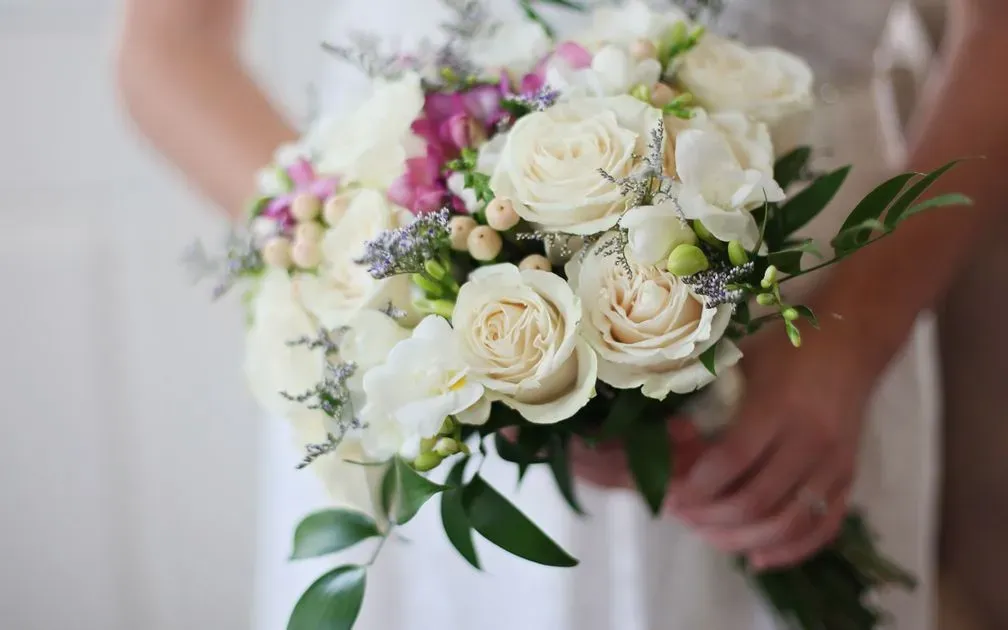
The bride, maid of honor, bridesmaids and flower girl carry bouquets, while groomsmen and family wear boutonnieres or corsages. Size bridesmaid bouquets at about three-quarters of the bride's.
Count stems by role and round up to full bunches. Order 2 to 3 weeks before delivery, and have flowers arrive about 2 days before the wedding. My advice? Build every piece from the bride's colors, just smaller, because a shared palette ties the party together better than identical bouquets do.
Key Points
- Bridal Guide's rule of thumb, passed along by a 2026 New York City bridal guide, keeps bridesmaid bouquets about three-quarters the size of the bridal bouquet.
- Our DIY floral design stem count guide puts a typical bridal bouquet at 30 to 35 stems and a bridesmaid bouquet at about 15.
- Blooms By The Box advises ordering 2 to 3 weeks before your delivery date, or as early as 120 days ahead, with flowers arriving about 2 days before the wedding.
Wedding party flowers are where a floral budget quietly grows. The Knot's 2025 Real Weddings Study put the national average spend on wedding flowers at $2,723. In New York City, brides in 2026 typically spent $2,500 to $7,000+ on full wedding florals, and delivery alone can run $150 to $400 in Manhattan, which brides there call their "number-one surprise" in consultations.
Price is the deciding factor for most couples. In 2018, 70% of surveyed couples said price was their top priority when choosing a florist. Full-service work also comes with a long runway: a San Francisco Bay Area wedding florist wrote in 2025 that 6 to 12 months of pre-planning sits behind the single week of hands-on work.
Building your own bouquets from bulk stems skips most of that runway. You don't need a design deck. If a blank page feels daunting, our wedding flower packs and curated collections give you a ready mix of bulk flowers to start from and add to.
One question helps before you shop: which single flower should every piece share with the bride's bouquet? Write your answer at the top of your planning page, and keep it in view while you browse and while you build.
I've laid this guide out in that order, because each decision feeds the next one. You'll see who needs flowers, which bouquet style suits each person, how big each piece should be next to the bride's, and how many stems it all takes, then a timeline that has everything arriving about 2 days before the wedding.
You already know the bride carries a bouquet. The harder part is everyone else: who carries flowers, how big each piece should be, and how many bulk stems it takes to make them all match. Here's a good first question to settle: which attendants will carry a bouquet, and which will simply wear a flower?
Wedding party bouquets are the flowers carried or worn by the people standing with the couple. For example, the maid of honor, bridesmaids and flower girl carry them, while groomsmen, parents and grandparents usually wear boutonnieres or corsages. Those pieces add up fast. In 2018, a national survey of couples put average wedding flower spending at $2,800, a figure that bundled the bride's bouquet, a boutonniere, wedding party flowers and centerpieces together. A 2026 New York City bridal guide priced a bridal bouquet alone at $250 to $600 there, and it named the number of bridesmaid bouquets and boutonnieres as a main cost driver.
Headcount shapes your budget as much as flower choice does. I'd map every role on paper before picking a single variety, since the bride's bouquet sets the palette every other piece has to echo.
So start with people, not petals.
Questions this article answers
Who in the wedding party needs a bouquet or personal flowers?
The bride, maid of honor, bridesmaids and flower girl usually carry flowers, while the groom, groomsmen, parents and grandparents wear boutonnieres or corsages. Count people first, stems second.
You probably already have a rough head count in your phone. Here's how to turn it into a flower list in a few minutes:
- Write down everyone who walks down the aisle or stands up front.
- Mark each person as carrying flowers or wearing flowers.
- Add the extras people forget: a toss bouquet, the officiant, readers and grandparents.
- Circle the one or two pieces that should stand out, usually the bride's bouquet and the maid of honor's.
Two terms come up again and again. A boutonniere is a small flower piece pinned to a jacket lapel, for example one spray rose with a sprig of seeded eucalyptus. A corsage is the same idea worn on the wrist or pinned to a dress, the classic choice for mothers and grandmothers.
| Role | Piece | What to keep in mind |
|---|---|---|
| Bride | Bridal bouquet | Sets the recipe and colors for everyone else |
| Maid or matron of honor | Bouquet | Often a touch fuller than the bridesmaids' |
| Bridesmaids | Bouquets | Smaller versions of the bride's recipe |
| Junior bridesmaids | Small bouquet or posy | Light enough for younger hands |
| Flower girl | Petals, posy or crown | Freeze-dried rose petals can be ordered ahead |
| Groom | Boutonniere | Repeats the bride's main flower |
| Groomsmen, fathers, ring bearer | Boutonnieres | One matching recipe for all |
| Mothers and grandmothers | Corsages | Wrist or pin-on, your choice |
Why does a written list matter so much? Because the best wedding party flowers are planned as a set. Wedding Chicks showed the format back in 2014 by publishing a bridesmaid bouquet as a written bouquet recipe, meaning a list of every variety that goes into one bouquet, so your own list for spray roses, waxflower and seeded eucalyptus works the same way. Repeat one recipe like that for every attendant and the bouquets read as a family in photos.
That's the takeaway. A recipe beats a guess.
Our wedding work at Blooms By The Box has been featured on Style Me Pretty, Ruffled and Wedding Chicks, and I'll be honest with you: the pretty pictures on those pages never show the list that came first. The habit behind them is the same: write the roles down before you shop. Once your list is done, browse our popular wedding flowers for DIY designs with your names and pieces in hand.
Don't worry if your list keeps changing. Add a cousin, drop a reader, and the plan still works.
Next comes the question that decides your stem count more than any flower choice: how big should each of those bouquets be?
Which bouquet style should each person carry?
Choose the style before the size, because style sets stem count and build time. Since 2007, Blooms By The Box has supplied fresh flowers and greens, and simple styles suit most DIY parties.
You've likely saved a dozen bouquet photos already. Before you fall for one, run each style through these three questions:
- How long will one bouquet take to build, and how many of them do you need?
- Has anyone on your team practiced this shape before?
- Does the style still look right with fewer stems?
Here's where the trouble starts. A posy is a small, round, hand-held bouquet, for example a tight cluster of spray roses and waxflower with a little greenery. A cascade is a bouquet that trails down from the hands, like a waterfall of flowers and vines. Both are lovely. They are not equally kind to a DIY timeline.
The bridal style guide at bespoke-bride.com, updated in 2026, puts real numbers on that gap. It estimates a posy at 20 to 30 minutes to build and a classic round dome at 45 to 60 minutes, while a cascade runs 90+ minutes. The same guide rates the cascade as advanced DIY and says it is best left to a florist unless you have practiced the structure in advance. It also notes that a posy typically uses 10 to 20 stems.
| Style | Estimated build time | Skill level | Good fit for |
|---|---|---|---|
| Posy | 20 to 30 min | Beginner DIY | Bridesmaids, junior bridesmaids, flower girl |
| Hand-tied garden | 30 to 45 min | Beginner DIY | Bride or maid of honor |
| Classic round dome | 45 to 60 min | Beginner DIY | Bride |
| Asymmetric | 60 min | Intermediate DIY | Bride with a practiced helper |
| Cascade | 90+ min | Advanced DIY | Bride only, after a practice run |
Now picture that cascade times every bridesmaid. The hours stack up fast. Contrary to what a pinned photo suggests, the fullest style is rarely the right style for the whole party.
Stems stack up too. Our average wholesale price is $3 to $4 per stem for bulk wedding varieties, so every extra stem in a fuller style shows up in your total. With wholesale pricing, a lush look stays within reach for the bride, while a simpler shape keeps attendant bouquets easy on time and budget.
A hand-tied garden style is my favorite middle ground for first-timers. It forgives a loose stem, and our wholesale garden wedding flowers give you soft, open shapes that don't need perfect placement.
Pick one style for the bride. Pick one simpler style for everyone else.
That second choice is where size comes in, and size is where most stem counts quietly go wrong.
How big should each wedding party bouquet be?
Size the bride's bouquet to her dress first, then make each bridesmaid bouquet about three-quarters as big, and plan three or four stems for each boutonniere.
You've already picked a style for each person. Now comes the question that shapes your stem order more than any other: how big? Here's how to set sizes, in this order:
- The bride first: match her bouquet's width to the shape of her dress.
- Bridesmaids next: make each bouquet about three-quarters the size of the bride's.
- Maid of honor: give her a smaller version of the bride's bouquet, not a twin.
- Boutonnieres last: three or four stems, with one focal flower.
Start with the dress. Diameter is simply how wide a bouquet measures across its face, from one edge to the other. For example, a bouquet as wide as a dinner plate reads as full, while one the width of a saucer reads as petite.
A 2026 NYC bridal flower guide from bespoke-bride.com ties bouquet width to dress silhouette like this:
| Dress silhouette | Bouquet shape | Diameter |
|---|---|---|
| Ball gown or princess | Full, round bouquet | 12 inches or more |
| A-line or fit-and-flare | Medium hand-tied | 9 to 11 inches |
| Sheath or column | Small posy or single stem | 7 to 9 inches |
| Tea-length or mini | Petite nosegay | 6 to 8 inches |
| Heavily embellished dress | Simpler, smaller design | Go smaller than the silhouette suggests |
A nosegay is a small, round, tightly gathered bouquet. Think of it as a posy pulled in snug: for example, a handful of spray roses wrapped close with ribbon so only the blooms show.
The same guide passes along Bridal Guide's rule of thumb that bridesmaid bouquets should be about three-quarters the size of the bridal bouquet. Its reasoning is that attendant flowers should "support the bridal bouquet, not compete with it," because identical bouquets make "the bride disappear a little." One Tribeca bride said it plainly: "My MOH had a smaller version of mine, and you could always tell immediately who the bride was in every shot."
Smaller attendant bouquets keep the bride in focus. They also trim your order, since the guide is blunt that more stems mean more cost. When I'm unsure between two sizes, I'd lean toward the smaller one, because a compact bouquet still looks generous in a bridesmaid's hands.
Weight counts too. As the guide warns, "If you pick something that weighs five pounds, you're going to know about it by cocktail hour." That matters most for the bride, who carries hers longest.
Boutonnieres stay small on purpose: three or four stems built around one focal flower, pinned on the left lapel with the stem pointing down, plus a little wire support if the day involves lots of walking.
The good news is that every size on this list can come from one order. Blooms By The Box keeps an extensive selection of bulk flowers and greenery, and our customers rate us 4.7 out of 5 across 11,700+ verified Shopper Approved reviews, with 75% five-star. If blush is your shade, our wholesale pink flowers for DIY weddings let the bride's bouquet and the bridesmaids' share one color family at different sizes.
With each width settled, the next job is turning those sizes into a stem count you can actually order.
How many stems does each wedding party bouquet actually take?
Ask how many flowers one bouquet needs, and the honest answer comes back as questions: how big, how full, and in what style?
Our own DIY floral design stem count guide gives starting numbers. A typical bridal bouquet takes 30 to 35 stems, and some reach 40. A bridesmaid bouquet takes about 15 stems, including five stems of greenery, and a smaller one about 10. A textured boutonniere takes three or four stems, and a wrist corsage takes two greenery stems, one focal flower and 3 to 5 secondary flowers.
Next to the sizing rule in the section above, those counts come as a surprise. Bridal Guide's rule of thumb, as cited by the wedding site bespoke-bride.com, makes bridesmaid bouquets about three-quarters the size of the bride's. In stems, though, our guide puts a bridesmaid bouquet at about half of a typical bridal bouquet, and a smaller one at about a third. Width and stem count measure different things, so neither rule cancels the other. Together they show that a bouquet's size on its own won't give you the stem count. So start the count with something firmer: the bride's own bouquet, and its style.
Style is where the numbers move most. Writing about the floral consultations it has sat in on with brides in New York, bespoke-bride.com named the most common mismatch between inspiration photos and stem counts:
"Brides fall in love with a layered, lush bouquet on Pinterest without realizing that 'lush' is code for 'three times as many stems.'"
bespoke-bride.com, guide to bridal flowers in New York City, 2026
At the other end, the same site's bouquet style guide says a posy typically takes 10 to 20 stems and calls it the most budget-friendly style to make from wholesale flowers. A lush bouquet and a loose one can look about the same width in photos and still need very different numbers of stems. Whatever style the bride picks also sets the stem count for everyone else, because every other piece is scaled from hers.
Once the bride's count is fixed, you can decide where the money goes within it. A florist giving budget advice in Style Me Pretty in 2013 warned that "Flowers for large parties add up fast!" Her fix was to use the costlier blooms in the bride's bouquet and "go for less expensive blooms in the bridesmaids' bouquets." She pointed to carnations for their texture and alstroemeria for their range of colors, which "work great" when paired with a few more expensive blooms.
Boutonnieres can match without a separate recipe. Our guide builds each one from a single focal flower, a filler and two greenery stems. Make the groom's from the main flower in the bride's bouquet, and give the groomsmen the less dominant color in the scheme. Every boutonniere then repeats a flower that is already on the stem list.
The last surprise comes after the counting. Your stem list and your order are rarely the same number, because flowers are sold by the bunch and a list rarely lands on a full bunch. The extra stems are not waste. A snapped stem on the wedding morning, a boutonniere for a late addition or a bud vase for the gift table can all come from them.
From stem list to order
- Your plan needs 16 stems of one variety.
- The variety comes in bunches of 20.
- You order the full bunch of 20 and have 4 spare stems.
Check the stems per bunch on each product page before you round.
We sell flowers by the stem, bunch and box, so we have a stake in how this math comes out. The rounding still happens on our pages too. Each product page lists the stems per bunch, and that is the number to round each variety up to.
Each count leads back to one bouquet. The bride's style decides how many stems fill her bouquet. A bridesmaid bouquet takes about half of that count, a smaller one about a third, and boutonnieres borrow flowers already on the list. The order then ends up larger than the stem list, because flowers are sold by the bunch.
- Choose the bride's bouquet style before you count anything. A lush version of the same size can take several times the stems.
- Count the bride's bouquet stem by stem first. Then plan each bridesmaid bouquet at about half of that count, or about a third for a smaller one.
- Put the costlier focal flower in the bride's bouquet, and fill the bridesmaids' bouquets with texture flowers such as carnations or alstroemeria.
- Make the groom's boutonniere from the bride's main flower and give the groomsmen the scheme's second color, so no extra variety enters the order.
- Round every variety up to full bunches, and decide before the flowers arrive where the spare stems will go.
How we checked this
We drew on our own 2024 DIY floral design stem count guide, two 2026 guides from the wedding site bespoke-bride.com, and a 2013 Style Me Pretty feature with budget advice from a florist. The counts in our guide are starting points for typical bouquets, not fixed rules, and your own recipe may need more or fewer stems. The bespoke-bride.com sites don't explain how they arrived at the posy stem range or the "three times" figure. Beyond that guide, our only figures are the stems per bunch on our product pages. We sell flowers by the stem, bunch and box, so a larger order benefits us. Still unknown: none of our sources measured how the stem count changes as a bouquet gets bigger.
- Blooms By The Box, "DIY Floral Design Stem Count", July 27, 2024.
- bespoke-bride.com, guide to designing bridal flowers in New York City, April 6, 2026.
- bespoke-bride.com, guide to wedding bouquet ideas and styles, April 26, 2026.
- Style Me Pretty, "6 Floral Tips for Smaller Budget Weddings" with advice from a florist, November 13, 2013.
What should you do first to plan your wedding party flowers?
Write down every person who carries or wears flowers, size each piece against the bride's bouquet, then turn those sizes into one stem list you can order.
Once you see the party as one design, the math gets friendlier. Every bouquet pulls from the same short list of varieties, so you count each variety once for the whole party instead of bouquet by bouquet. Then you round each total up to how that variety is sold, so needing 16 stems from bunches of 20 means ordering the full bunch.
I think that rounding habit matters more than any single flower choice. Spare stems become backup boutonnieres. Matching gets easier, too, when every bouquet pulls from the same buckets.
Here's your next step: put the wedding date on your calendar and count back. Place your order 2 to 3 weeks before delivery, and plan for the flowers to arrive about 2 days before the wedding so they have time to drink and open.
Summarize This Article With AI
Open this article in your preferred AI engine for an instant summary.
Frequently Asked Questions
What else do people ask about wedding party bouquets?
Most questions come down to timing, matching, care and cost. Here are clear answers so you can finish your flower plan with confidence.
When should I order flowers for my wedding party?
Order 2 to 3 weeks before your delivery date, or as early as 120 days ahead. Under 2 weeks, some items may be unavailable. Schedule delivery for about 2 days before the wedding so the flowers can rehydrate and open.
Should the groom's boutonniere match the bride's bouquet?
Yes, ideally. A boutonniere is the small flower pinned to a jacket lapel. Make the groom's from the bride's main flower, then give the groomsmen the second color from your palette.
How do I care for bouquet flowers after they arrive?
Unbox them right away. Remove the sleeve and any leaves below the water line, recut each stem at least 1 inch at a 45 degree angle, and set them in lukewarm water. Let them hydrate, meaning drink, for at least 3 to 5 hours, ideally overnight, and give roses at least 12 hours. Keep them cool, never cold, and never in a refrigerator.
Is DIY really cheaper than a florist for wedding party bouquets?
Often, yes. A florist's quote pays for design, delivery and assembly on top of the flowers, and when you build the bouquets yourself, you pay for the flowers. I'll be honest, though: DIY trades money for your time. Plan a build day, and line up a helper or two, before you count the money saved.
Do you ship wedding flowers nationwide?
Yes, we deliver nationwide within the continental US. Fresh flowers and greens ship by FedEx Priority Overnight for delivery Tuesday through Friday, and supplies such as freeze-dried petals ship separately by FedEx Ground. For help planning your order, call our Customer Service Team at 1-855-BUY-BLOOMS.
Written by
Joan
Owner, Blooms By The Box
Joan Wyndrum is a co-founder of Blooms By The Box, an online destination for fresh wholesale flowers and floral supplies.
Connect on LinkedIn