
Quick Answer
Carnations, chrysanthemums, alstroemeria and standard roses are the wedding flowers that hold up best shipped in bulk, with days of vase life to spare after delivery.
Peonies, dahlias and garden roses are riskier. They are gorgeous. Their vase lives run much shorter, though, so use them as accents.
Short on prep time before the event? I'd lean harder on those four sturdy varieties when you order wholesale flowers online. Lily of the valley sits at the fragile end, because it needs water until the last possible moment.
Key Points
- On Blooms By The Box product pages, carnations and chrysanthemums last 8 to 10 days, alstroemeria 7 to 10, and peonies and garden roses just 2 to 3.
- In a January 2024 r/florists thread, a florist rated imported carnations and exotic mums "safe" and South American roses "usually safe," but said peonies and dahlias "don't travel well."
- Our guidance is to order 2 to 3 weeks before your delivery date and schedule delivery about 2 days before the event, so flowers can rehydrate and open.
Order wholesale flowers online from a supplier that stocks hardy varieties year-round, then choose blooms for the whole wedding day, not one photo, since bouquets work for hours.
Event-ready is the real test. An event-ready flower is open, hydrated and holding its shape at the moment you need it, not just alive when the box lands. Picture a bouquet that has to look fresh from getting-ready photos and portraits all the way down the aisle and into the reception.
Growers plan around that moment too. In a 2024 episode of The Backyard Bouquet Podcast, the host noted that weddings make up 50 to 60% of the business of Heather Staten, a farmer-florist in Hood River, Oregon. She cuts her subscription bouquets tight so clients get "a week or 10 days of flowers," but for a wedding she wants each bloom "completely open at its maximum beauty." Even she buys dahlias from other local farmers when a wedding is too big to supply alone.
Peak timing beats long life on a wedding day. That's why predictable varieties matter so much when your flowers travel. A carnation gives you room to get the timing right, and a fragile bloom gives you very little.
Here's what you'll find below:
- Variety ranking: which flowers arrive ready to use, and which need a backup.
- Care after delivery: how to keep stems fresh between the doorstep and the ceremony.
- Choosing a supplier: what to check before you order bulk flowers on a budget.
I'd start with the ranking, because every other choice depends on which flowers you trust to travel.
You've probably noticed that every bulk flower site promises fresh stems, yet few of them tell you which varieties still look event-ready after the trip. I'd argue that's the question that matters most. Our extensive selection of bulk flowers and greenery holds both kinds of stems, those that shrug off a trip and those that don't, so check each pick before it goes in your cart. The difference is how much life each stem has left after the trip.
So what does traveling well mean? A flower travels well when it comes out of a dark, dry box, takes up water and holds its shape until the ceremony. For example, a carnation has days to spare after the trip, while a peony has almost none. Every stem still needs conditioning when it lands, which simply means waking it back up: strip the lower leaves, cut each stem at an angle, set it in fresh water and keep it at the right temperature. Skip that step, and flowers wilt.
Fragile favorites are where plans fall apart. Cathy O'Connell of COJ Events told Wedding Chicks that lily of the valley is stunning in photos but "only viable if it's kept in water until the last possible second." Its vase life runs just 3 to 6 days, so a stem that spends part of that traveling has little left for the photos, the aisle and the reception. Fall for a bloom on a screen, then check how it travels. The ranking below starts with the flowers you can lean on.
Which wedding flowers arrive event-ready after shipping?
Carnations, chrysanthemums, alstroemeria and standard roses are the safest flowers to ship for a wedding. Peonies, garden roses and dahlias carry the most risk, and ranunculus sits in between.
Before you build your order, run each flower on your wish list through three quick questions:
- How long does it last in a vase? A longer vase life gives your flowers a cushion after the box trip.
- Are the petals firm or soft? Tight, sturdy heads ride out bumps. Soft petals that bruise easily do not.
- Is it the star or a supporting player? Let hardy flowers carry the design and give delicate ones a smaller role.
Our own product pages put numbers on the first question. Carnations and chrysanthemums list a vase life of 8 to 10 days, and alstroemeria lists 7 to 10. Peonies and garden roses list just 2 to 3 days on most of their pages, and dahlias list 4 to 6.
Working florists draw the same line from the shipping side. In 2024, a florist on r/florists rated imported carnations and exotic mums as "safe" and South American roses as "usually safe," while naming peonies and dahlias among the small specialty flowers that "don't travel well."
| Flower | Ship-hardiness tier | Vase life on our product pages | What florists and buyers report |
|---|---|---|---|
| Carnations | Reliable | 8 to 10 days | Imports rated "safe" (2024) |
| Chrysanthemums | Reliable | 8 to 10 days | Exotic imported mums rated "safe" (2024) |
| Alstroemeria | Reliable | 7 to 10 days | No transit reports in our sources yet |
| Standard roses | Reliable | 5 to 7 days | South American roses "usually safe" (2024) |
| Eucalyptus and greenery | Reliable | Eucalyptus: 7 to 10 days | Hearty enough to share one bucket |
| Ranunculus | Conditional | 5 to 7 days | Delicate; needs its own container |
| Larkspur and delphinium | Conditional | 5 to 7 and 4 to 7 days | Imports rated "Meh" (2024) |
| Orchids | Conditional | 8 to 10 days | One florist received two boxes "completely moldy" |
| Hydrangeas | Conditional | 5 to 7 days | Can wilt overnight; our care guide's hot-water step revives them |
| Peonies | Accent only | 2 to 3 days | "Don't travel well" |
| Garden roses | Accent only | 2 to 3 days | Shortest vase life of the rose family |
| Dahlias | Accent only | 4 to 6 days | "Don't travel well" |
An analysis of 5 sources shows the same split: firm, long-lasting flowers reach the event with room to spare, and soft specialty blooms need a plan. The common assumption is that a flower that photographs beautifully will travel just as well. It often won't. Florists price peonies as premium because they are delicate, limited or seasonal, while carnations and many rose varieties stay the flexible choices that keep a design full.
So what does that mean for your order? Build your centerpieces and bouquets around the reliable tier. Then add one delicate favorite as an accent you can afford to lose a few stems of. Our average wholesale price is $3 to $4 per stem for bulk wedding varieties, so every stem that arrives usable stretches your budget further. Peonies are available March to July and dahlias May to September, so check the calendar before you fall for either one. Planning a fall date? Our guide to October wedding flowers ranked by vase life shows how the same thinking plays out month by month.
Picking the right variety is only half the job, though. The other half happens in your kitchen, between delivery day and the ceremony.
Which flowers do florists and DIY couples say survive the box?
Ask florists which wedding flowers ship badly and peonies come up fast. Ask couples who unpacked their own boxes, though, and a different flower keeps showing up in the stories of what went wrong.
Start with the florists. In a January 2024 thread on Reddit's r/florists, working florists compared notes on which imported flowers arrive in good shape. One rated imported carnations "safe," exotic imported mums "safe" and South American roses "usually safe." Another listed the small specialty flowers that "often don't travel well," and put peonies and dahlias first. A third gave the rule behind both lists: "Anything that bruises easily is a gamble in shipping."
Couples and home florists who handled the boxes themselves mostly agree. A commenter who says they have watched dozens of couples try DIY wholesale wrote, "I've seen brides up at 2am trying to fix wilted peonies." A home florist who held wholesale flowers from Monday until a Saturday wedding singled out dahlias as the most sensitive of her blooms. An online florist promoting its own bulk program calls chrysanthemums "Super hearty," but that comes from a sales pitch.
| Flower | Where practitioners put it | What they said |
|---|---|---|
| Carnations | Travels well | "safe" (florist, imported carnations, 2024) |
| Chrysanthemums | Travels well | "safe" (same florist); "Super hearty" (online florist's bulk program) |
| Standard roses | Travels well | "usually safe" (florist, South American roses) |
| Ranunculus | In between | "only if the stems are fat" (florist); "very very delicate" (DIY supplier) |
| Peonies and dahlias | Risky | "often don't travel well" (florist) |
| Hydrangeas | Risky | "all wilted overnight" (bride, 2022) |
Ranunculus is the true in-between flower. In an unpacking video from a DIY flower supplier, the presenter calls ranunculus "very very delicate" and gives them a container of their own. Yet one couple's pink ranunculus arrived on a Thursday and was "still very beautiful and in good shape" at their Sunday wedding. The florist who would risk imported ranunculus "only if the stems are fat" suggests what separates the two outcomes. A DIY bride who posted her wedding video in 2026 saw the same split in her online boxes: "the sturdier stems were totally fine," while some delicate ones arrived "damaged and unusable."
The sharpest surprise is the hydrangea, the big, full head that couples in these threads ordered by the dozen. In a 2022 r/wedding thread about keeping flowers alive for three days, one bride had made hydrangeas the main flower in all of her bouquets. "I did everything you're supposed to, and they still all wilted overnight," she wrote. She also said she "had no idea they were problematic." There is a rescue method, and it is the one our flower care guide gives: if hydrangeas wilt, re-cut the stems, stand them in hot water for 30 seconds, then move them straight into room-temperature water and give them several hours to revive. A former florist in the same thread swore by hot water too, while another commenter said it works "about 85% of the time," so a design that rests entirely on hydrangeas still deserves a backup.
Being event-ready also depends on what happens after the box arrives, and closed blooms on arrival are part of the plan.
What a normal box looks like
- On the mini carnations unpacked in one supplier's video, "half of them at least are closed."
- Carnations take "about two to three days" to open, the presenter says.
- Expect about five percent of blooms to be "a little bit off," she adds.
- Our own guidance is to have flowers delivered about 2 days before the event so they can rehydrate and open.
Line up the florists' lists and the couples' stories and they point to one trait. The box favors a tight bud on a sturdy stem. Carnations, mums and standard roses travel closed and open on your schedule. The gambles either bruise easily, like peonies, dahlias and thin-stemmed ranunculus, or can collapse even with careful handling, like the hydrangea. Every account here is practitioner experience or a single couple's report, so the tiers show where experienced people agree. Nobody in these sources counted how many stems survived.
- If hydrangeas are meant to carry every bouquet, decide now which sturdier flower could stand in for some of them.
- If ranunculus is on your list, ask your supplier, us included, how sturdy the stems are, give them a container of their own on arrival, and order extras at the higher end of the usual 10% cushion, as the 2026 DIY bride advises for online orders.
- Leave closed carnations and roses alone on delivery day and judge them after the two days our delivery guidance builds in.
How we checked this
We read Reddit threads from working florists, a home florist and wedding couples, published between 2022 and 2026. We also watched unpacking videos from two flower sellers and a DIY bride's wedding video. The 2-day delivery guidance and the care steps are ours. Every other account comes from anonymous or individual practitioners and couples, and we could not verify them. The florists' ratings describe imports as of January 2024. The two sellers have a commercial interest in their own programs. We sell all of the flowers discussed here, including hydrangeas and peonies, so we have a stake too. Still unknown: measured arrival rates by variety. Neither we nor any source here published them.
- r/florists, thread on which flowers ship worst, January 2024.
- r/wedding, thread on keeping flowers alive for three days, September 2022.
- r/wedding, thread on DIY wedding florals, March 2026.
- r/FloralDesign, thread on holding wholesale flowers Monday to Saturday, May 2025.
- Unpacking and conditioning video from a DIY flower supplier, December 2020.
- Bulk program video from an online florist, August 2024.
- Haley Post, DIY wedding flowers video, May 2026.
- Blooms By The Box, guidance published on bloomsbythebox.com: ordering, delivery and its flower care guide.
How do you keep shipped wedding flowers fresh between delivery day and the ceremony?
Treat the days after delivery as part of the plan: unpack right away, recut and hydrate every stem, then keep the buckets cool, dark and in fresh water.
You might think a few days at home is a shipping compromise. It isn't. Even a farmer-florist who grows her own wedding flowers spends the week before each wedding moving stems in and out of her cooler until they open to just the right stage. A hold is simply how wedding flowers get ready. That's why we suggest scheduling delivery about 2 days before your event, so the flowers have time to rehydrate and open.
DIY bride Haley Post, who made her own flowers for a Saturday wedding, processed everything on Thursday and arranged on Friday. For that processing day, here is the routine our flower care guide lays out:
- Unpack the day the box lands. Wholesale boxes are meant to be emptied into buckets right away, which is why sellers tell you how many buckets you'll need.
- Strip the low leaves. Remove any foliage that would sit under the water line, because it feeds bacteria.
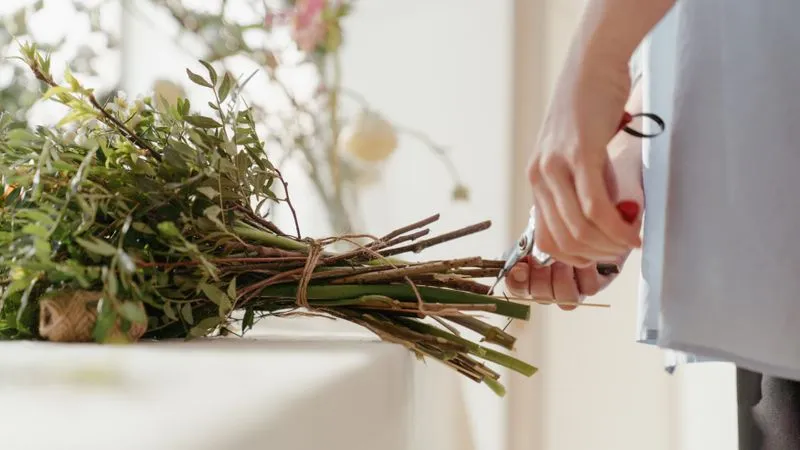
- Recut at an angle. Cut at least one inch off each stem at a 45 degree angle with sharp shears, under water if you can. Then set each bunch in lukewarm water. Flower food is optional. Our boxes ship without it.
- Let them drink. Give them up to 12 hours at room temperature, out of direct sunlight. Don't crowd the buckets. Roses need at least 12 hours before you arrange them.
- Refresh the water. Change it every two to three days, or sooner if it turns cloudy. Give the stems a fresh cut each time.
A few flowers need extra attention on delivery day. Our care guide spells them out. Roses arrive with their outer "guard petals" still on. Growers leave them to protect the blooms in the box, so gently pinch those off before you arrange. Garden roses are extremely delicate. They do not tolerate much handling, time out of water, or direct light and heat, so leave their arrangements until last. Dendrobium orchids that look wilted on arrival can be revived by submerging the whole spray in cool tap water for 15 to 30 minutes.
Where you keep the buckets matters as much as what's in them. On r/FloralDesign in 2025, a home florist who ran Monday deliveries for Saturday weddings through an entire first year, with no cooler at all, called that schedule "Totally doable." Their advice leaned on light as much as temperature: a dark basement or a room with blackout curtains helps, and even a room at about 60°F works if it's darker and cooler than the rest of the house. Keep the air conditioner from blowing straight onto the flowers, because moving air dries them out. A loose sheet of clear plastic laid over the top, never wrapped around the stems, holds in moisture.
What about the fridge? I wouldn't use it. Home fridges run colder than fresh flowers like. They have cold spots you can't see, and petals that touch the back wall can freeze or turn brown. Our FAQ is plain that exposure to heat or cold damages fresh flowers. Cool, not cold, is the goal: to slow the opening, our care guide says to use cool water and keep the flowers in a cool, dark place.
Here's what I'd do the day your box arrives. Hydrate everything right away, then sort the buckets into two groups: hardy stems go to a cool, dark room, and fragile stems go wherever you can check on them most easily, away from drafts and direct sun. Your carnations and mums can wait on the floor. Your dahlias and garden roses deserve the first look each morning.
If mums are carrying a big share of your design, our guide to florist mums vs potted garden mums helps you pick the right kind for arrangements.
All of this care pays off most when the box shows up in good shape to begin with, and that starts with who you order from.
How do you choose an online wholesale flower supplier for a DIY wedding?
Choose a supplier with a long shipping record, such as fresh flowers and greens shipped since 2007, verified reviews from real buyers, and a catalog deep enough for backup varieties.
You already read reviews before you buy shoes online. Flowers ask a little more of you. With hardy varieties picked and a hold plan ready, the supplier is the last big variable you control, and it decides how much care went into the box before it reached your door. Think of it as choosing who handles your flowers before they reach you.
Here's the order I'd check things in, from first to last:
- Track record: how many wedding seasons a company has spent packing live stems for travel. Blooms By The Box has shipped fresh flowers and greens since 2007. Whoever you consider, ask how long they have shipped wedding flowers, because a packing routine gets steadier with every season it survives.
- Verified reviews: ratings an outside platform collects from people who actually placed an order. A few glowing quotes on a homepage are hard to trace. Ours is a 4.7/5 average across 11,700+ verified Shopper Approved reviews, with 75% of them at five stars. Volume is the point. Thousands of verified buyers smooth out one lucky or unlucky shipment. Published wedding features add a second check, and our wedding work has appeared on Style Me Pretty, Ruffled and Wedding Chicks.
- Catalog depth: how many varieties a supplier carries, which decides whether you have a backup when your first choice is out of season or too delicate to travel. Say your heart is set on peonies for a fall date. A deep catalog lets you move to a hardier focal flower in the same order instead of starting over somewhere new.
Fillers belong in that same order. If you're still counting stems for bud vases and arches, our guide to how much baby's breath you need in bulk walks through the math.
One last check happens at checkout. In a 2022 planning thread, one buyer noticed a charge that appeared only when their order was marked for a wedding, then disappeared when they marked the same order as a general event. Fees like that are easy to miss. Read every line before you pay, and ask the supplier to explain any charge you don't recognize. A clear answer is a good sign, and you'll want it in writing before a single stem ships.
Which flowers should anchor a wedding order that ships?
Anchor your order with carnations, chrysanthemums, alstroemeria and standard roses, then add peonies or garden roses as accents, timed around their shorter vase life.
Here's why I'd build it that way. Peonies and garden roses give you only 2 to 3 days in the vase, so the two days between delivery and your event can use up most of their life before the first photo. Carnations and mums have days in reserve. Plan so a delay costs you an accent, never a centerpiece.
Plan for the trip itself, too. Our flowers ship by FedEx Priority Overnight. After the journey from our growers, they have been out of water for many hours, so they may look limp when you open the box. That is normal. Rehydrated right away, they recover. The two days our delivery guidance builds in give them time to drink and open. Looking ahead, I expect the stems florists already trust in transit to anchor more and more DIY weddings, with fragile favorites moving to the edges of the design where a tired bloom is easy to swap. My advice for today: build the order around the sturdy varieties, and give every stem water the moment the box arrives.
Frequently Asked Questions
What else do people ask about shipping wedding flowers?
Most questions come down to timing, extra stems and which blooms can be prepped early, so here are plain answers, starting with the flowers that travel best.
Which wedding flowers hold up best when shipped in bulk?
Carnations, chrysanthemums, alstroemeria and standard roses are the most dependable choices for a box that travels. Peonies, dahlias and garden roses work best as accents. A focal flower is the largest bloom that draws the eye first, like a rose at the center of a bouquet. I'd give that job to a hardy variety.
How many extra stems should I order for shipped wedding flowers?
Plan for overage, which means extra stems beyond your count to cover any that arrive damaged. DIY bride and YouTuber Haley Post notes the usual advice is "10% more than you think you need," and she suggests the higher end for online orders. In her boxes, the sturdier stems "were totally fine," while some delicate ones were not.
How far ahead should I order wedding flowers online?
Place your order 2 to 3 weeks before your delivery date. You can order up to 120 days in advance. Waiting until under 2 weeks out risks some items being unavailable.
Do you ship wedding flowers nationwide?
Yes. We ship premium fresh flowers nationwide, and you can start an order from our Buy Flowers & Floral Supplies page. Pick a delivery date that leaves your stems time to rehydrate before the ceremony.
Can I make wedding arrangements a few days early?
Yes, with sturdy flowers. The same DIY bride found stock sturdy enough for arrangements made a few days in advance. She also suggests making rose or ranunculus boutonnieres a day or two ahead. Keep finished pieces in a cool, dark place, away from heat, drafts and direct sun, as our care guide advises. Choose blooms that aren't fully open yet, because a wide-open flower may not last the extra day.
Written by
Joan
Owner, Blooms By The Box
Joan Wyndrum is a co-founder of Blooms By The Box, an online destination for fresh wholesale flowers and floral supplies.
Connect on LinkedIn