Quick Answer
Blue carnations are dyed white carnations, so some color can leave the stem. Keep dyed stems in their own water, away from linens and lapels, and choose muted blues that forgive drift.
Bleed is predictable. Hydrate dyed stems as soon as they arrive, then set one beside a scrap of your tablecloth overnight. That small trial shows you exactly where the blue will travel before the big day.
Key Points
- FloraLife's 2023 guide to handling dyed flowers calls tinted vase water "perfectly normal," because the stems contain dye that seeps back into the water.
- In its 2016 Generations of Flowers Study, the Society of American Florists found that 70% of Americans said the color of flowers added to the impact of a gift.
- Blooms By The Box advises ordering 2 to 3 weeks before your delivery date , up to 120 days ahead, with delivery about 2 days before the event.
If you've ever held a dusty blue swatch next to a bucket of flowers and wondered how to make them match, you're in good company. In a 2019 r/weddingplanning thread, a bride planning a palette of cream, medium and dusty blues and touches of orange asked the question many couples quietly wonder: "Would it be weird to have something like blue roses? Would anyone notice or care?"
Here's my honest answer. Guests notice blue. They simply notice the wrong blue faster than the right one, and a stem that leaves a streak on a tablecloth gets noticed fastest of all.
The good news is that blue doesn't have to be everywhere to count. One featured olive, ivory and white wedding kept its only blue to the bride's pumps "with a blue crystal buckle." Small dose. Big effect. Think of blue as a seasoning, not the whole meal, and you'll make calmer choices about where dyed stems belong.
Below, you'll find where dye causes trouble, which shades read as natural, and how to keep color off linens and lapels. None of it calls for a florist's workroom. A single bouquet and boutonniere can come together in an hour or two from start to finish, which means a practice run fits easily into one ordinary weeknight before the big week arrives.
So grab one stem and ask one question first: where will this blue actually sit?
You already know blue carnations don't grow that way in a field. What surprises most couples is where the blue goes next: into the vase water, onto a white tablecloth, or across a groom's lapel. So here's a question to carry through this guide: what will each blue stem touch? The research section below shows which kinds of bleed matter.
Here's what the term means. Dye bleed is color that leaves a dyed stem and settles somewhere else, like a pale blue ring on an ivory linen. A quilting tutorial on preventing fabric dye bleed with Retayne puts the timing plainly: "you do it in advance," before any color runs, and that timing works for dyed stems too.
Timing matters too. A wedding planner's checklist for DIY couples asks a blunt question: "Do I have an extra 10-12 hours the week of my wedding to prep and build my arrangements?" The same checklist notes that different flowers have different care needs, from water temperature to the number of days they take to open. Dyed stems add one more need to that list.
I'll be honest, that question cuts both ways. It's a fair warning, yet it also shows the whole job fits inside a single planned week, which is far more doable than it feels at midnight with a Pinterest board open. So let's start with the question every couple asks first.
Questions this article answers
Are blue carnations real or dyed?
Blue carnations are dyed: they begin as white carnations that take up colored dye, so the blue sits in the stem and petals rather than coming from the plant itself.
Before you order a single bunch, run through these three quick checks:
- Placement: Will each blue stem sit near a gown, a suit lapel or a white tablecloth, or safely inside a vase?
- Water: Will the dyed stems share a bucket or vase with white or pale flowers?
- Shade: Do you need a saturated blue, or a softer blue you could build partly from naturally blue-toned flowers?
Your answers decide how much bleed control you need. That's the whole game.
You probably already know carnations as the dependable, ruffled flower in grocery bouquets. Here's the new idea. A dyed flower is a fresh bloom that has been given a color it doesn't grow on its own, usually by letting the stem drink a dye solution so the pigment travels up into the petals. For example, a pure white carnation goes into colored water and comes out sky blue, navy or cobalt.
That's not a knock on the flower. The common assumption is that dyed means second-rate, but real weddings tell a different story. Wedding Chicks featured a 2020 micro wedding in Los Angeles whose flower list named "Custom dyed blue Carnations" as focal flowers, which tells you the blue was added, not grown. The palette was described as "muted shades of blue focal flowers" against blooming branches. Dyed stems carried the color. Natural stems added depth up close.
Our own wedding work has been featured on Style Me Pretty, Ruffled and Wedding Chicks, so I pay close attention when a blog like Wedding Chicks gives a dyed carnation the starring role. It tells me couples are choosing blue on purpose. It also tells me the dye is going to touch more linens, lapels and white petals than ever.
Of the 4 sources behind this section, none describes a carnation that grows blue on its own. In practice, that means every blue carnation you buy carries some dye that can move. So when you shop, check whether a blue stem is listed as dyed, because that one word tells you to plan its water and its placement.
If you're still choosing stems for a fall date, our guide to October wedding flowers ranked by vase life shows how long common wedding flowers hold up once they're arranged, which matters when blue carnations will sit in water for several days before and after the ceremony.
So where exactly does the dye go once those stems hit water? It starts with the bucket.
Where does blue carnation dye cause the most trouble at a wedding?
Dye causes the most trouble where blue stems touch fabric or white petals: boutonnieres on lapels, centerpieces on light linens and bouquets held against an ivory gown.
Here's the catch nobody mentions on the inspiration board. The spots where couples most want a pop of blue are the same spots where loose dye can do real damage.
Think about how blue usually shows up. Style Me Pretty featured a 2020 wedding at the Historic Walton House in Florida built on a dusty rose palette, with navy added for the groom. In the couple's own words, he "went with the navy blue because it was a bold color with his skin tone and helped bring gravitas to the softness and elegance of the dusty rose." The designers carried that navy into the decor through a navy blue-and-white linen at a cocktail hour that had no flowers at all.
Notice where the blue lived. On the groom. On the table linen. Right up against fabric.
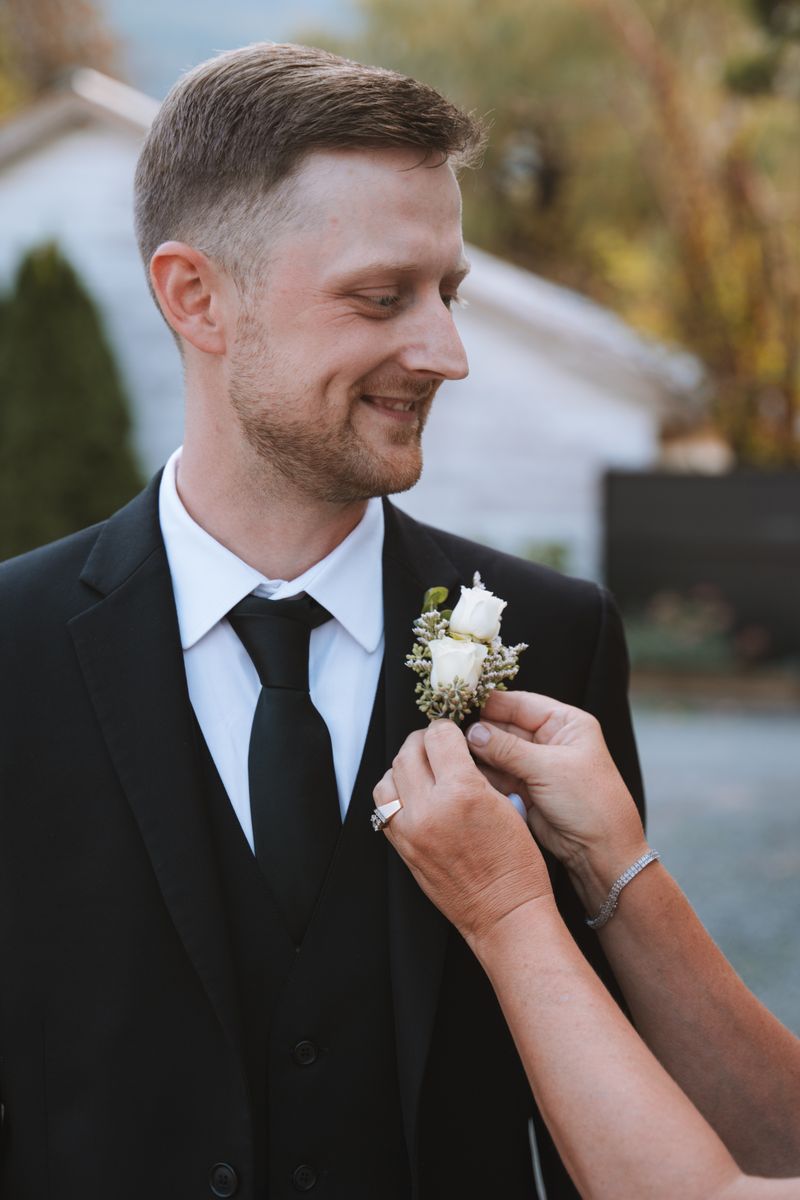
Now picture a dyed blue carnation boutonniere pinned to a light gray suit, or a low centerpiece of blue carnations resting on a blush tablecloth. A damp stem end or a wet leaf is all it takes to leave a mark. On a navy suit you might never see it. On ivory, blush or white, you will, and so will your photographer.
That's the tradeoff in plain terms:
- Before: blue carnations tucked into a bridesmaid bouquet, stems wrapped wet, held against a pale dress for an hour of photos.
- After: the same blue carnations, stems dried and wrapped in ribbon, with the bluest blooms angled away from the fabric.
Same flowers. Very different risk.
The reason so many couples reach for carnations in the first place is cost. At Blooms By The Box, where we've been providing fresh flowers and greens since 2007, our average wholesale price is $3 to $4 per stem for bulk wedding varieties. That makes a dyed carnation one of the friendliest ways to put saturated blue on every table. In my view, that's exactly why the handling plan matters more, not less. When a flower is easy to buy in volume, it ends up in more places, and each extra place is one more chance for dye to meet a tablecloth.
The same goes for white filler. If you're pairing blue carnations with airy white sprays, our guide to how much baby's breath you need will help you count stems, and you'll want to keep in mind that those tiny white blooms show any stray tint first.
So the risk is real, and it's concentrated. The next question is how blue you actually want those carnations to be, because the shade you pick changes how much dye is in play.
Which kinds of blue carnation bleed are harmless, and which can stain?
Put dyed blue carnations in a clear vase and within a day or so the water usually turns blue. It looks like a warning. The evidence we found puts the real warnings somewhere less visible.
FloraLife makes flower care products. In 2023 it published a handling guide for florists who process dyed flowers, and its verdict on tinted water is blunt: "The water changing color is perfectly normal, don't worry." "The stems contain dye," the guide says, so some of that color seeps back into the water the stems stand in. A blue vase means the stems are behaving the way dyed stems do.
How the color got in tells you where it can go next. One commenter in Reddit's askscience forum remembered a school experiment in which white carnations stood in colored water, and the petals showed "veins of colour" within a day or two. A single person's memory doesn't prove much. It does show the route, though: the dye rides up the stem with the water, into the petals and the leaves.
How the dye travels
- A white carnation drinks dyed water, and the color rises through the stem into the petals and leaves.
- Back in plain water, the stem gives some dye back, and the vase turns blue.
- From there, the color spreads three ways: into water shared with other flowers, out through the leaves, and onto any fabric those leaves or wet stems touch.
Drawn from FloraLife's 2023 guide to handling dyed flowers.
White flowers come first. FloraLife warns that natural flowers sharing water with dyed stems may pick up some of the tint. The guide even suggests the result "can actually enhance the look of your overall design as the tint would be subtle." In a dusty, layered palette, a faint blue wash on a few blooms might look intentional. If you need white roses to stay crisp against the blue, that same wash ruins the effect.
Next come the leaves, a dyed stem's weak point. Salts and oils in the dye often "burn the leaves slightly," the guide says, while the blooms stay "perfectly intact." The leaves are also a way out for the dye. "Be aware the dye can seep through the leaves," FloraLife writes.
Dye leaking from the leaves explains the guide's firmest instruction: avoid contact "with clothing or tablecloths as dye could transfer." FloraLife also tells florists to warn customers about the risk at the time of purchase. A problem that a seller's guide tells sellers to raise at the counter deserves attention.
| Where the blue shows up | What it means | The precaution |
|---|---|---|
| Vase water | Normal. The stems are releasing dye. | Use a vase that isn't clear and won't be damaged by tinted water. |
| White flowers in the same water | They may pick up some of the tint. | Use separate buckets and vases if the white has to stay white. |
| Leaves | Often lightly burned by the dye, and a place where dye can seep out. | Check leaves on any stem that will touch fabric. |
| Clothing and tablecloths | Dye can transfer on contact. | Keep dyed stems and leaves off fabric while handling and on display. |
Wedding design keeps putting dyed stems and fabric side by side. A 2020 Wedding Chicks feature on a Los Angeles micro wedding used custom-dyed blue carnations as focal flowers. The same wedding had hand-dyed silk ribbon on the tablescape and a silk linen draped behind the ceremony flowers. On the Planning Collective podcast in October 2025, a planner with more than 20 years in the business predicted bold, layered color for 2026 and 2027. The examples included cobalt blue paired with marigold yellow, and velvet linens layered with hand-dyed silk napkins.
The same planner suggests testing color combinations at a showroom appointment, with pieces from several vendors brought to one table, but also notes the florals can't be reproduced there. So the moment that matters most for bleed, a damp dyed stem resting on that napkin, is the one moment no mock-up shows.
The blue you can see in the vase is the blue you can ignore. The blue that causes damage moves by touch: a leaf against a lapel, a wet stem end on a napkin, a white bloom sharing a bucket. At a wedding, bleed comes down to distance, and the layered palettes planners now predict put dyed stems and fabric closer together.
- Choose a vase that is not clear and that tinted water won't damage, and keep changing the water every 2 to 3 days or when it turns cloudy, as our care guide advises.
- If any white flowers in the design have to stay white, hydrate the dyed carnations in their own bucket from the moment you unbox them.
- Look closely at the leaves on any dyed stem that will rest against fabric, such as a boutonniere or a bouquet handle.
- If someone else is building your boutonnieres, ask whether the stems are dyed and how they will keep leaves and wet stem ends off lapels.
- At a showroom mock-up, ask your planner where the dyed arrangements will physically sit relative to hand-dyed napkins or pale linens.
How we checked this
Our main sources were a 2023 dyed-flower handling guide from FloraLife, a 2020 Wedding Chicks wedding feature, an October 2025 planning podcast, and a 2012 Reddit thread. The only guidance of our own is the water-change schedule from our flower care guide. FloraLife sells floral care products, and its guide is written for florists processing dyed stems. It reports no tests on wedding fabrics. The podcast comes from a machine-generated transcript, so we paraphrased it rather than quoting it. The Reddit detail is one person's memory of a school experiment. We sell fresh wedding flowers, so we have a stake in this topic. Still unknown: which fabrics stain most easily, whether flower-dye stains wash out, and how long dyed stems keep releasing color. None of our sources tested those questions.
- FloraLife, care and handling guide for dyed flowers, March 1, 2023 (first published in LivRio Magazine, February 2023).
- Wedding Chicks, something blue micro wedding in Los Angeles, October 2020.
- Wedding Planning Collective Podcast, episode on 2026 and 2027 wedding trends, October 2025.
- Reddit r/askscience, thread on how multicolored flowers are dyed, March 2012.
- Blooms By The Box, flower care guide.
Which shade of blue looks best in wedding flowers?
Muted, dusty blues usually look best in wedding flowers because they read as soft and believable, while bright royal blue tends to stand out as unnatural up close.
Most couples recognize blue comes in a lot of moods. Navy feels formal. Sky blue feels breezy. With dyed stems, though, the shade you pick decides something bigger: whether guests see a beautiful flower or a colored one.
Couples have been weighing this for years. In a 2019 r/weddingplanning thread about flowers in unnatural colors, the bride who started the conversation pointed out that "not many flowers are naturally blue." The replies that followed kept landing on shade, not on whether blue belonged at a wedding at all. One commenter wrote that a "really shocking blue" looked "cheesy," while blooms that were "more muted" looked "great." Another said a "bright, plasticky royal blue" would stick out to them.
Shade matters more than the dye itself. Guests react to how a blue looks, not to how it got into the petals. With dyed carnations, though, you choose a color family, not an exact shade. Our blue carnations are a dyed product, so their saturation and shading can vary, with hints of white and purple next to brighter and lighter blues.
Here's how I'd think about the three main directions:
- Dusty or light blue: a soft, grayed blue, like faded denim. It blends easily with ivory, blush and greenery, so it holds up in a bouquet that people will see from a foot away.
- Navy: a deep, dark blue. It reads as polished and formal, which makes it a natural fit for small accent pieces.
- Bright royal blue: a saturated, electric blue. It grabs attention fast, so save it for a bold palette where that punch is the whole point.
For example, picture a stem of light blue delphinium tucked between cream blooms and eucalyptus. It looks calm. Swap in a bright blue carnation in the same spot, and every eye goes straight to that one stem.
If you're planning your first DIY wedding, I'd lean toward the dusty end of the range and let more than one flower carry the color, such as light blue delphinium and blue hydrangea next to a few dyed carnations, because a palette spread across several textures looks richer than a single dyed variety repeated on every table. Choosing a shade from a screen can feel risky. Don't worry, you don't have to guess alone. At Blooms By The Box we carry an extensive selection of bulk flowers and greenery, and our customers rate us 4.7 out of 5 across more than 11,700 verified Shopper Approved reviews, so you can ask us before you commit.
If you plan to soften your blue with white filler, our guide on how much baby's breath you need will help you count stems. Before you settle on a shade, hold one dyed stem next to your white flowers and linens in daylight, because that side-by-side view is what your photos will show.
What should you do next with your blue wedding flowers?
Your next step is a small test: order a few blue stems early, hydrate them beside your white flowers and linens, and watch how the shade and water behave.
Color carries real weight with guests. In its 2016 Generations of Flowers Study, the Society of American Florists found that 70% of Americans said the color of flowers added to the impact of a gift. A wedding table isn't a gift, yet the same instinct is at work. People notice color first.
That's exactly why I think dyed blue carnations deserve a spot in more wedding plans, not fewer, as long as you plan for where the color travels. Build that into your schedule now, and give your dyed stems their own prep evening on the calendar.
So here's your first move. Set one dyed stem in a clear glass of water, lay a scrap of your table linen beside it, and check both in the morning.
Summarize This Article With AI
Open this article in your preferred AI engine for an instant summary.
Frequently Asked Questions
What else do people ask about blue carnations at weddings?
Most questions come down to timing, care and trends: when to order, how to hydrate dyed stems, and whether bold blue still fits a 2026 or 2027 wedding.
Is blue still a popular wedding color for 2026 and 2027?
Yes. On the Wedding Planning Collective Podcast in 2025, a planner with more than 20 years in weddings named bold, layered color as a 2026 and 2027 trend, with cobalt blue paired with marigold yellow among the examples. Layered color means stacking several tones on purpose, like a deep blue bloom against a warm gold napkin.
How can I test a blue color combination before the wedding?
That same planner recommended testing combinations in person, with linens and other pieces together on one table, because some pairings didn't work once seen. Bring one dyed stem along. It tells you more than a photo will.
Can dyed blue carnations share a bucket with white flowers?
I wouldn't risk it. Give dyed stems their own bucket so your whites stay crisp white.
When should I order blue carnations for my wedding?
Order 2 to 3 weeks before your delivery date, and up to 120 days ahead if you like to plan early. Schedule delivery about 2 days before the event so the stems can rehydrate and open.
How do I care for blue carnations when they arrive?
Unbox them right away. Recut at least one inch at a 45 degree angle into lukewarm or room-temperature water, strip leaves below the waterline, and let them drink 3 to 5 hours, ideally overnight, in a cool room. Never put them in the refrigerator.
Can Blooms By The Box ship wedding flowers to me?
Yes. We ship premium fresh flowers nationwide, so your blue stems can come straight to your door, your venue or your planner.
Written by
Joan
Owner, Blooms By The Box
Joan Wyndrum is a co-founder of Blooms By The Box, an online destination for fresh wholesale flowers and floral supplies.
Connect on LinkedIn